


A hotel towel quality checklist built on ASTM D5433 gives purchasing managers a defensible, numeric pass/fail framework for every bulk shipment. Pass thresholds to enforce immediately:
- GSM: 500–600 GSM for standard guest-room bath towels; 400–500 GSM for hand towels and washcloths
- Breaking strength: A minimum breaking strength is required per D5433 Table 1 for terry products, with numeric thresholds set by the standard
- Dimensional change: Length and width shrinkage limits after laundering are set as thresholds in D5433, with length shrinkage around 10% max and width shrinkage capped at approximately 5%
- Colorfastness: Grade 3 minimum (laundering, crocking, light) per D5433
- Absorbency: Towels should absorb water within a short timeframe as defined by D5433 criteria
Pro Tip: Require pre-washed samples (3–5 industrial cycles) with every first shipment. New-item inspection misses shrinkage, lint shedding, and seam failures that only appear after laundering.
Key Takeaways
A D5433-aligned hotel towel quality checklist, with numeric GSM targets, pile construction specs, and enforceable PO clauses, is the single most effective tool for reducing post-delivery disputes and controlling total cost of ownership.
| Point | Details |
|---|---|
| Specify beyond GSM | Always pair GSM targets with fiber type (long-staple cotton) and yarn type (ring-spun) on every PO. |
| Enforce D5433 thresholds | Require 178 N minimum breaking strength, ≤10% length shrinkage, and Grade 3 colorfastness as batch release conditions. |
| Require pre-washed samples | Laundered samples (3–5 cycles) reveal shrinkage and seam failures that new-item inspection cannot detect. |
| Calculate cost-per-use | Divide purchase price by expected cycles; a $4.50 towel at 75 cycles ($0.06/use) outperforms a $2.80 towel at 35 cycles ($0.08/use). |
| Gjergjihtextil as your partner | Gjergjihtextil offers custom manufacturing, pre-wash sample service, and lab testing coordination for hotel towel procurement. |
Table of Contents
- What Does a Complete Hotel Towel Quality Checklist Cover?
- What ASTM D5433 Requires and How to Read the Numbers
- How to Run an Incoming Inspection on Towel Shipments
- How to Calculate Cost-Per-Use and Set Replacement Cadence
- Copy-Ready Spec Template and PO Clauses
- How to Vet Suppliers and Maintain Ongoing Quality
- What Buyers Consistently Get Wrong About Towel Procurement
- Gjergjihtextil Supports Your Towel Procurement Process
- Primary Sources and Further Reading
- Sources
What Does a Complete Hotel Towel Quality Checklist Cover?
A procurement spec sheet that covers every field below eliminates ambiguity between buyer and supplier before a single carton ships.
Identification fields
- SKU, item description, intended use (guest room, pool, spa, back-of-house)
- Supplier name, factory location, production batch reference
Material and yarn
- Fiber: 100% long-staple cotton (Egyptian, Turkish, or Pima grade preferred)
- Yarn type: ring-spun (not open-end/OE) for durability and softness
- Yarn count: 16/1 to 20/1 for pile; 20/1 to 30/1 for ground
GSM targets by towel type — 500–600 GSM is the hospitality standard for mid-range to upscale properties:
Dimensions and tolerances
- Bath towel: 27" × 54" (±1"); hand towel: 16" × 28" (±0.75"); washcloth: 12" × 12" (±0.5")
- Skew/bow: ≤2% of length
Construction details — pile height around 3.5 mm with 500 GSM is the target for hotel-grade terry:
- Loop type: uncut terry (both sides), or cut pile for spa applications
- Pile height: 3.0–3.5 mm target; loop density: ≥28 loops per cm²
- Hem/selvage: double-turned, chain-stitched or bar-tacked at corners
Performance requirements
- D5433 breaking strength, dimensional change, colorfastness, and absorbency (see Section 3)
- Laundered appearance: no pilling, no significant color shift after 5 wash cycles
Certifications and documentation required
- OEKO-TEX Standard 100 for guest-contact safety; MADE IN GREEN for sustainability claims
- ISO 9001 factory certification or equivalent QMS evidence
- Third-party lab test reports (SGS, Intertek, or Bureau Veritas)
- Pre-shipment wash sample photos (3–5 cycles)
Packing and logistics fields
- MOQ, lead time, packing method (poly-bagged per dozen, master carton count)
- Pre-shipment inspection terms and lab release condition stated on PO
What ASTM D5433 Requires and How to Read the Numbers
ASTM D5433 is the U.S. performance specification for institutional and household towel products. It sets numeric minimums across five test categories, organized in Table 1 (terry) and Table 2 (non-terry). Procurement teams should reference Table 1 for all standard hotel terry towels and require suppliers to submit test reports against these thresholds as a condition of batch release.
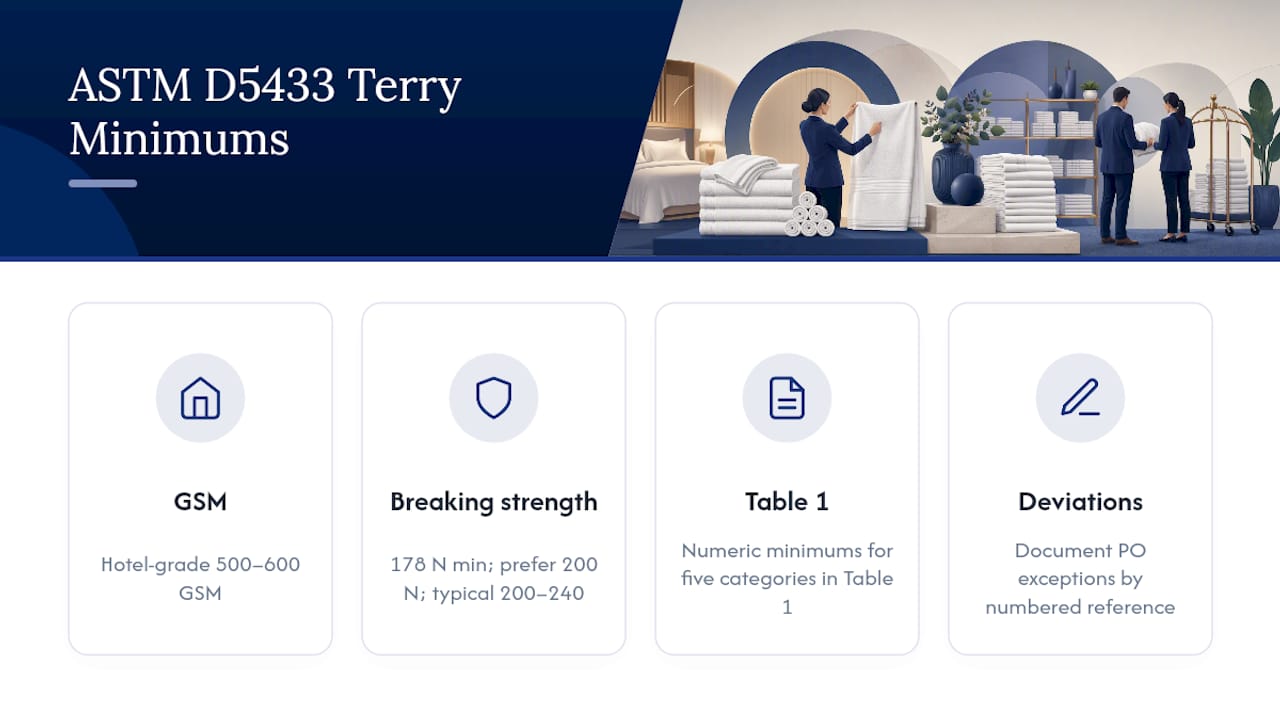
Hotel-grade bath towels at 500–600 GSM with ring-spun long-staple cotton typically test at 200–240 N breaking strength, comfortably above the 178 N floor. Treating 178 N as the absolute minimum and 200 N as the preferred target gives you a practical two-tier threshold: reject below 178 N, flag for review between 178–199 N.
D5433 allows purchaser and supplier to modify specific thresholds by mutual agreement. When you negotiate a deviation (for example, a lower colorfastness grade on a natural-dye product), document it explicitly in the PO as a numbered exception referencing the specific D5433 table row. Undocumented deviations become disputes.
How to Run an Incoming Inspection on Towel Shipments
Incoming inspection is where the spec sheet either pays off or reveals its gaps. A structured sampling plan and a consistent on-dock workflow produce defensible accept/reject decisions.
Sampling plan
- Lot ≤1,000 units: inspect 32 pieces minimum, randomly selected across at least 5 cartons
- Lot 1,001–10,000 units: inspect 50 pieces from at least 10 cartons
- Stratify by carton position (top, middle, bottom) to catch packing inconsistencies
On-arrival checks (visual and dimensional)
- Carton integrity: no moisture damage, crushing, or broken seals
- Label verification: fiber content, GSM, country of origin, care symbols match PO
- Dimensional spot check: measure 10 pieces per lot with a steel tape; flag any piece outside the ±1" tolerance
- Visual defects: loose loops, dropped stitches, uneven pile, hem gaps, color streaking
- Odor check: chemical smell may indicate residual finishing agents; flag for lab testing
Quick onsite tests
- Pocket absorbency: drop a 1" water bead on the terry face; it should absorb within 10 seconds
- Dry crocking: rub a white cotton cloth firmly across the face 10 strokes; Grade 3 staining is the pass line
- Seam pull: grip hem and ground fabric 2" apart and pull firmly; any separation is an automatic reject
Lab tests to order on first shipments or when onsite tests flag issues
- ASTM D5034 (breaking strength), AATCC 135 (dimensional change), AATCC 61 (colorfastness to laundering), AATCC 79 (absorbency sink time)
- Use SGS, Intertek, or Bureau Veritas for accredited results
Decision rules and paperwork
- Pass: release cartons, file test report with PO record
- Hold/quarantine: isolate affected cartons, photograph defects, issue a written non-conformance report (NCR) to the supplier within 48 hours
- Reject: formal rejection notice with photo evidence, D5433 threshold reference, and remediation deadline (typically 30 days)
Pro Tip: Ask suppliers to submit pre-washed samples (3–5 cycles) alongside each first shipment. This single step surfaces shrinkage and seam failures before the full lot is accepted, dramatically reducing post-acceptance disputes.
How to Calculate Cost-Per-Use and Set Replacement Cadence
Textile durability directly drives total laundry cost; a towel that fails at 40 cycles costs far more per use than one that holds to 90, even at a higher purchase price. Hotel-grade terry at 500–600 GSM with long-staple cotton typically withstands 50–100 industrial wash cycles before pile degradation or hem failure requires replacement.
Cost-per-use formula:
Cost per use is calculated by dividing the purchase price by the expected usable cycles of the towel
A $4.50 bath towel rated for 75 cycles costs $0.06 per use.
On industrial laundering: keep extractor speed at 600–700 RPM for towels above 500 GSM. Speeds above 800 RPM can cause irreversible pile crushing in heavier fabrics. Wash temperatures of 140–160°F (60–71°C) are standard for sanitation without accelerating fiber degradation, provided the detergent is pH-neutral to mildly alkaline.
Copy-Ready Spec Template and PO Clauses
Paste these fields and clauses directly into your RFQ or purchase order.
Spec template fields (minimum required)
- Product ID / SKU: [buyer-assigned]
- Description: [e.g., Bath Towel, 27"×54", 550 GSM, 100% Long-Staple Ring-Spun Cotton]
- Fiber content: 100% long-staple cotton; no blends without written buyer approval
- GSM: [target] ±5%
- Finished dimensions: [L × W] ±1" (bath towel); ±0.75" (hand towel); ±0.5" (washcloth)
- Pile height: 3.0–3.5 mm; loop density: ≥28 loops/cm²
- Performance standard: ASTM D5433 Table 1 (terry); all thresholds apply unless noted below
- Required certifications: OEKO-TEX Standard 100; ISO 9001 or equivalent
- Required documents with shipment: packing list, Certificate of Analysis (COA), third-party lab report (SGS/Intertek/Bureau Veritas), pre-wash sample photos
Sample PO clauses
- Pre-shipment sample approval: “Supplier shall submit 12 pre-washed samples (minimum 3 industrial wash cycles) for buyer approval prior to production release. Production shall not commence without written approval.”
- Third-party lab testing: “All shipments are subject to third-party lab testing per ASTM D5433. Buyer reserves the right to select the testing laboratory. Cost of testing for non-conforming shipments is borne by supplier.”
- Batch release condition: “Shipment release is conditional on passing D5433 thresholds. Supplier shall provide lab reports no later than 5 business days before scheduled ship date.”
- Non-conforming goods: “Goods failing D5433 thresholds shall be subject to rejection, rework at supplier’s cost, or a credit equal to the cost differential, at buyer’s election. Supplier has 30 days to remedy or replace.”
Pro Tip: When you agree to a D5433 deviation (e.g., a relaxed colorfastness grade for a natural-dye product), add a numbered exception line to the PO: “Exception 1: AATCC 61 colorfastness grade minimum reduced to Grade 2 by mutual agreement, ref. email [date].” This prevents the deviation from being used as a blanket excuse for other failures.
Documents to receive with every shipment: packing list, COA, third-party lab report, pre-wash sample photos, and factory audit summary (for new suppliers).
How to Vet Suppliers and Maintain Ongoing Quality
Supplier QA is not a one-time audit. It is a governance rhythm that keeps product consistency from drifting across production batches.
Supplier evidence checklist
- ISO 9001 certification (current, not expired)
- OEKO-TEX Standard 100 certificate covering the specific product category
- Third-party lab accreditation: SGS, Intertek, or Bureau Veritas preferred
- Production batch testing records for the last three shipments
- Factory audit report (within 24 months) from a recognized auditor
KPIs to track per supplier
- First-pass acceptance rate (target: ≥95%)
- Average cycles-to-failure from wash testing (track against spec)
- Colorfastness failure rate per batch (target: <2%)
- On-time delivery rate (target: ≥90%)
- Complaint resolution turnaround (target: ≤10 business days)
Governance rhythm
- Pre-production gate: approve material swatches and yarn samples before cutting begins
- Pre-shipment test: require lab report and pre-washed samples before release
- Quarterly performance review: score supplier against KPIs; share results in writing
- Corrective action plan (CAP): any KPI breach triggers a written CAP with a 60-day resolution window
Use pilot orders of 200–500 units to validate a new supplier’s full production before committing to scale. Batch testing for loop uniformity, tensile strength per ASTM D5034, and absorbency on pilot lots reveals production-floor consistency that sample swatches cannot. Shared QC checklists and joint wash testing sessions build the working relationship that makes corrective actions faster and less adversarial. For broader sourcing best practices, Gjergjihtextil’s B2B hospitality sourcing guide covers supplier evaluation in more depth.
What Buyers Consistently Get Wrong About Towel Procurement
After 30 years supplying hotel-grade textiles to properties including Marriott, Meliá, and Sheraton, the pattern of procurement mistakes is consistent and avoidable.
The most common error is treating GSM as the sole quality indicator. A 600 GSM towel made from short-staple open-end yarn will pill, shed lint, and fail breaking-strength tests faster than a 500 GSM towel made from ring-spun long-staple cotton. GSM must be paired with fiber quality and yarn type to predict real performance. Buyers who specify only GSM on their POs are leaving the most important variables uncontrolled.
The second mistake is skipping pre-wash sample review. New towels look and feel acceptable almost regardless of construction quality. The problems — shrinkage beyond spec, hem separation, color bleeding — only appear after three to five industrial cycles. Requiring laundered samples adds one week to the approval process and eliminates the most common source of post-delivery disputes.
A practical approach for mid-scale properties: run a mixed GSM program. Use 550 GSM for guest-room bath towels where guest perception matters most, and 450–480 GSM for pool and back-of-house applications where turnover is higher. This balances guest experience against laundry cost without compromising either end of the operation. Replacement cadence should be driven by the cost-per-use calculation, not by a fixed calendar interval — a towel that still passes a quick crocking test and seam pull at cycle 80 does not need replacing.
Gjergjihtextil Supports Your Towel Procurement Process
Gjergjihtextil brings over 30 years of supply chain experience to hotel towel procurement, with a track record that includes supplying Marriott, Meliá, and Sheraton properties. For purchasing managers who need more than a catalog, the offering covers custom manufacturing to your exact GSM and dimension spec, pre-wash sample preparation, third-party lab testing coordination, and bulk logistics from import to delivery.

The practical next step for procurement teams is to request a QA spec review or a set of laundered samples against your current PO spec. Gjergjihtextil’s hotel textiles page outlines the full product range and performance standards, and the hotel textile selection guide walks through cost-saving specification decisions in detail. Contact the team directly to schedule a supplier audit support session or to get a bulk quote aligned to your D5433 requirements.
Primary Sources and Further Reading
Use these sources when specifying test requirements, selecting certifications, or briefing a third-party lab.
- ASTM D5433: The foundational U.S. performance specification for institutional towel products. Purchase a copy directly from ASTM International to access Tables 1 and 2 with full numeric thresholds.
- B2B Towel Certifications and Quality Standards Guide (Alibaba Seller Blog): Covers GSM segmentation, OEKO-TEX vs. MADE IN GREEN certification selection, and pre-wash sample guidance for B2B buyers.
- Hotel GSM Buying Guide (RMT Hospitality): Maps hotel category to recommended GSM ranges and guest expectations; useful for calibrating spec targets by property tier.
- Terry Fabric Technical Guide (Jinchen): Detailed construction parameters including pile height, loop density, and tensile trade-offs; reference for writing construction specs on POs.
- Third-party lab partners: SGS, Intertek, and Bureau Veritas all offer ASTM and AATCC testing services in the United States. Use a certified lab for any shipment where onsite tests flag a potential failure or when onboarding a new supplier.
- For operational maintenance tracking across your property’s textile inventory, the maintenance tracking guide from Realtevo offers a practical framework for cycle-based replacement scheduling.
Sources
- D5433 Standard Performance Specification for Towel Products for Institutional and Household Use
- Bath Towel Certifications and Quality Standards: A Complete B2B Buyer Guide – Alibaba.com Seller Blog
- Terry Fabric Characteristics: Complete Technical Guide for B2B Buyers | Jinchen