

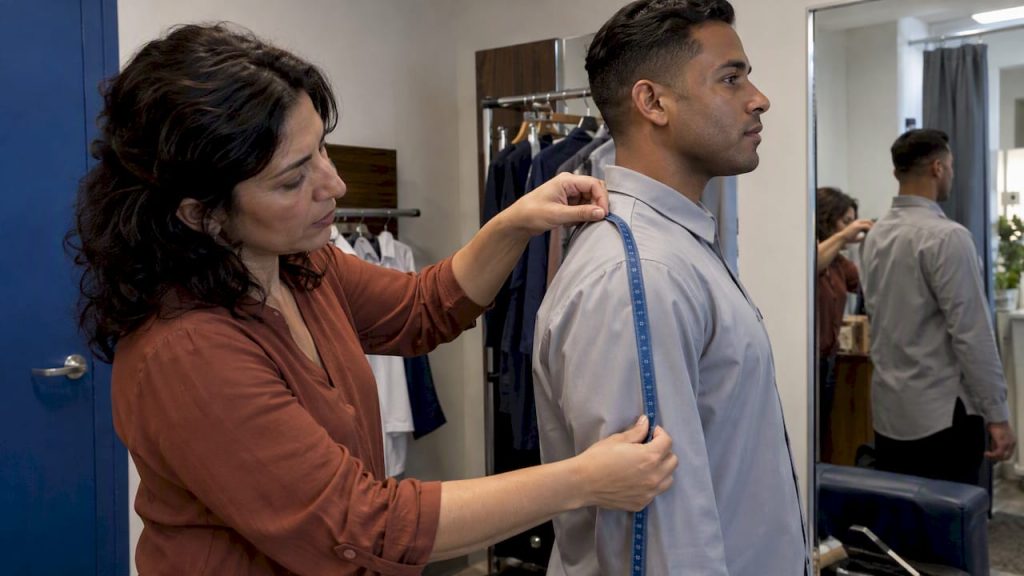
To measure staff uniforms correctly, take body measurements (not garment sizes) with a soft tape, over fitted clothing, one person at a time, and record every figure on a single chart that you send to your supplier. Do it once, properly, and you avoid the reorders, alterations and mismatched fits that make a front-desk or dining-room team look uneven. This guide shows which points to measure, how to lay out the chart, how to handle in-between sizes and how to run the process for a whole property.
TL;DR
- Measure the body, not an existing garment. Professional sizing systems are built on body measurements, as ISO 8559-1:2017 describes.
- Core points: chest or bust, waist, hip, inseam, sleeve length, neck (for collared shirts), shoulder width and height. Add role-specific points for kitchen and housekeeping staff.
- Use one chart per employee, filled in by a second person, with date, role, gender cut, and the garment each size is for.
- When a figure falls between sizes, decide by role: size up for movement-heavy jobs, tailor down for guest-facing roles.
- Order a small fitting batch first, then place the bulk order once the sizes are confirmed.
Table of Contents
- Why measuring matters more than most managers expect
- Body measurements versus garment measurements
- What you need before you start
- How to take each measurement
- Designing a uniform measurement chart
- Adapt the measurements to the role
- When the numbers fall between sizes
- Running the process for a whole property
- Fit check: ten minutes that save a reorder
- Common mistakes to avoid
- Our view: why we treat sizing as a procurement decision
- Ordering uniforms from a supplier that makes them
- FAQ
- Sources
Why measuring matters more than most managers expect
A uniform that does not fit costs you in three ways. Staff move less freely, so service slows. Guests see an inconsistent team. And in kitchens, laundry and maintenance, loose cuffs or over-long trousers become a safety issue.
That last point has a legal side in Albania. Our research points to the Inspectorate of Labour’s collection of health and safety legislation, under which employers must provide suitable protective and functional work clothing. Clothing that does not fit the person wearing it cannot do that job. If you manage a kitchen or a laundry, check the exact obligations for your roles with the labour inspectorate or your safety adviser.
There is also a presentation side. Uniform presentation forms part of the standards that accommodation properties are assessed on, and the Ministry’s page on the categorization of accommodation structures is where you start if your property is going through that process. We treat uniforms as operating infrastructure rather than a line to be cut: they affect how fast people work and how consistent the guest’s impression is from one shift to the next.
Body measurements versus garment measurements
The most common mistake is to ask staff what size they normally wear and order accordingly. Retail sizes differ between brands and countries, and they drift with fashion. A person who wears an M in one shop wears an L in another.
Professional systems avoid this by working from the body. ISO 8559-1:2017 sets out anthropometric definitions of the measurements used to build clothing size systems, so that a chest girth means the same thing wherever it is taken. You do not need to buy the standard to use the principle: record what the body measures at defined points, and let the supplier match those figures to the size table of the specific garment.
A garment measurement, such as the width of a shirt laid flat, is the supplier’s figure. A body measurement is yours. Keep the two separate and you can compare any chart to any supplier.
What you need before you start
- A flexible tailor’s tape, in centimeters. A metal or fiberglass builder’s tape does not follow the body.
- A printed chart, one per person (layout below).
- A second person to measure. Self-measuring is the main source of error, because people twist to read the tape and pull it tight.
- A wall or door frame and a pencil for height.
- Fitted clothing on the person: a thin T-shirt and leggings or slim trousers. Thick or baggy layers add centimeters that do not belong to the body.
Set aside about five to ten minutes per person, in a private room. Staff measure more honestly when they are not in the corridor.
How to take each measurement
The person stands upright, relaxed, feet slightly apart, arms down, looking ahead. The tape should lie flat and touch the body without pressing. A good test: you can slide one finger under it.
Upper body
| Point | How to measure | Used for |
|---|---|---|
| Chest / bust | Around the fullest part, under the arms and straight across the back | Shirts, jackets, tunics, aprons |
| Waist | Around the natural waist, the narrowest point, above the navel | Trousers, skirts, waistcoats |
| Neck | Around the base of the neck, where a collar sits | Collared shirts |
| Shoulder width | Across the back from one shoulder point to the other | Jackets, blazers |
| Sleeve length | From the shoulder point, over a slightly bent elbow, to the wrist bone | Long-sleeved shirts, jackets |
| Back length | From the base of the neck to the waist | Tunics, waistcoats, chef jackets |
Lower body
| Point | How to measure | Used for |
|---|---|---|
| Hip | Around the fullest part of the hips and seat | Trousers, skirts |
| Inseam | From the crotch to the ankle bone, along the inner leg | Trouser length |
| Outseam | From the waist down the outer leg to the ankle | Check on inseam |
| Skirt length | From the waist to the desired hem | Skirts and dresses |
Height and other details
Record height, because it decides between regular, short and long fittings. For footwear, if you supply it, measure the foot standing, in centimeters, and note the width. Add head size only for chef hats or caps.
Take every measurement twice. If the two readings differ by more than a centimeter, take a third and note it. Write down the figures as you take them rather than trusting memory.
Designing a uniform measurement chart
People who search for a uniform measurement chart usually want something to print and fill in. You can build one in a spreadsheet in ten minutes. A chart that works for a hotel team has these fields:
- Header: employee name, department, role, date measured, name of the person who measured.
- Cut: men’s, women’s or unisex cut. Offer the choice. Forcing a cut is a common reason for rejected garments.
- Body measurements in centimeters: height, chest/bust, waist, hip, neck, shoulder, sleeve, inseam.
- Garment block: a row per garment (shirt, trousers, jacket, apron, tunic) with a column for the size ordered and a column for “fits / adjust” after the trial.
- Fit preference: slim, regular or relaxed, because kitchen and housekeeping staff often prefer more room.
- Notes: left-handed, pregnancy, injury, prosthetic or any need that changes the cut. Handle this field discreetly.
- Signature and date: the employee confirms the figures. This avoids disputes later.
Print the unit on the chart (cm) in bold. Charts that mix centimeters and inches create the worst errors, especially if a supplier or a trainee works from a foreign template.
Adapt the measurements to the role
A front-desk jacket and a chef’s tunic do not fail in the same way. Decide what each role needs before the fitting session.
Reception and concierge. Presentation comes first. Shoulder width and sleeve length matter most, since a blazer that is off at the shoulder cannot be fixed cheaply. Measure for a close but comfortable fit.
Restaurant and bar service. People reach, bend and carry. Allow movement across the back and at the elbow. Check that trouser length works with the shoes staff will actually wear. For fabric choices in these roles, see our hotel uniform fabric options guide.
Kitchen. Look for room at the chest, shoulders and thigh. Sleeves should not drag into the pan or the hot plate. Heavy, hard-wearing fabric tolerates industrial washing; our kitchen uniform specifications describe the weights we work with.
Housekeeping and laundry. Staff bend, kneel and lift for hours. Measure with a little more allowance at the hip and seat, and keep trouser hems clear of the floor. Fabrics must cope with frequent washing.
Maintenance and technical staff. Fit is a safety question. Garments should not hang loose around moving equipment. Check the relevant safety requirements with your adviser before choosing the cut.

When the numbers fall between sizes
This is the question managers ask most. A person measures a medium at the chest and a large at the hip. What do you do?
- Order for the largest measurement, then tailor. It is easier to take a garment in than to let it out. For guest-facing roles, this gives the cleanest result.
- Size up for physical roles. In kitchens and housekeeping, comfort and safe movement outrank a sharp silhouette.
- Split sets. If the supplier allows it, order a jacket in one size and trousers in another. Check this before the order, since not every program supports separate sizing.
- Allow for the wash. Fabrics can shrink slightly (rrudhosje) after repeated laundering. Ask your supplier for the expected shrinkage of the specific fabric and whether it is pre-shrunk, and keep the figure on file. Do not size down in the hope that the garment will relax.
If the difference between two sizes is large, or the person is outside the standard range, ask for made-to-measure. That is where in-house production is useful, and we cover it below.
Running the process for a whole property
Measuring one person is simple. Measuring 80 across three shifts needs a plan.
- Appoint one lead. One person, usually the housekeeping manager or the HR coordinator, owns the charts. One consistent hand beats six different measuring styles.
- Schedule by department. Book short slots so that no department loses its whole shift at once.
- Measure everyone, including long-serving staff. Bodies change, and old sizes are often wrong.
- Add a buffer. New hires, turnover and seasonal staff mean you will need sizes you have not measured yet. Keep the blank chart and a note of the supplier’s standard sizes for the quick fit.
- Digitize the chart. Put all figures in one spreadsheet: name, role, sizes per garment. Your supplier can then check it, and you can reorder in minutes.
- Order a fitting batch first. Ask for one sample of each size per garment. Have staff try them on, record adjustments in the “fits / adjust” column, then confirm the bulk order.
- Plan the replacement cycle. Uniforms wear at different rates, depending on role and laundering. Log reorders by size so that next year’s order is based on data. For linens, the same logic appears in our replacement cycle guide for Albanian hotels.
Fit check: ten minutes that save a reorder
Once the sample garments arrive, ask the person to put them on and perform the movements of their role. Check these points:
- Raise both arms, reach forward and bend over. The shirt should not pull out of the trousers or tighten across the back.
- Sit down. The waistband should not dig in, and the trousers should not ride up above the ankle.
- Check the shoulder seam sits at the shoulder point, not on the upper arm.
- Sleeves end at the wrist bone for long sleeves. They should not cover the hand.
- Collar closes without a gap and without pinching.
- Hems clear the floor, particularly in kitchens and wet areas.
- Look at the whole team side by side. Colors, lengths and silhouettes should read as one uniform, even when the sizes differ.
Record every issue on the chart and give the list to your supplier before bulk production starts. A change at sample stage is cheap. A change after 200 pieces are cut is not.
Common mistakes to avoid
- Measuring over thick clothing. Jackets, jumpers and heavy jeans add centimeters.
- Pulling the tape too tight, or letting it sag at the back.
- Using the old uniform as the reference. The old uniform may have been wrong from the start.
- Mixing units. Keep to centimeters throughout.
- Skipping the signature. Without confirmation, a dispute about whose figures were wrong is hard to settle.
- Ignoring comfort preference. Two people with the same figures may want different fits.
- Ordering the full run before the trial. Always test samples.
Our view: why we treat sizing as a procurement decision
We have supplied the hospitality sector in Albania since 1994, and we import, design and produce in one operation. That gives us a particular view of uniform sizing: most fit problems begin before the order, in the data, rather than in the factory.

When the chart is complete and consistent, we can match each person to the right size in our ranges, flag the people who need a custom cut and plan production without surprises. When the chart is thin, everyone pays for it: the hotel in reorders, the supplier in returns and the staff in daily discomfort.
We also advise treating the first order as the start of a long-term supply arrangement. A property that keeps its size data up to date, logs replacements and sends us the same chart format each year gets repeat orders that match the first batch in color, cut and fabric. For a team that wears the uniform every day, that consistency matters more than the unit price of any single garment. If cost is your main constraint, our guide on saving on Albanian hotel uniforms covers where the money actually goes.
— Xpert
Ordering uniforms from a supplier that makes them
If you have your charts ready, the next step is a conversation about ranges and fabrics. We import and produce hospitality uniforms, and we can tailor garments to a client’s specification. Our work uniforms page describes the offer, and if your team needs custom cuts or fabrics, our tailoring and production service is the place to start. Send us your completed charts and tell us the roles, and we will discuss sizes, samples and a supply plan with you. For a broader view of the choices, read our workwear textile options explained.
FAQ
Should staff measure themselves?
It is better if a second person does it. Self-measurement tends to produce a tape that is too tight, twisted or slack, and the figures are less reliable. If you have no choice, ask staff to measure each other in pairs, with the chart in hand, and have a manager check any unusual figures.
How do I measure staff uniforms if employees work remotely or at different sites?
Send the same printed chart and a short instruction sheet to each site, and name one person there to take the measurements. Ask them to return the chart as a scan or photo, with the signature. You can then match sizes centrally and send samples if anything looks unusual.
Do men and women need different charts?
The body points are almost the same, but women’s charts rely on bust and hip, and men’s on chest and neck. Use one template with both fields, and let each person choose the cut. This keeps the data in one format.
How often should I re-measure staff?
Measure every new employee at hiring, and re-measure existing staff before each major reorder, or whenever someone reports a change in fit. Many properties do a full review once a year, alongside the review of uniform stock.
Can I use one chart for several garments?
Yes. The body measurements are the same for every garment. Add a block listing each garment, its size and its fit result. That way one chart follows the person from the first fitting to the next reorder.
Sources
- ISO 8559-1:2017, anthropometric definitions for clothing size designation
- Inspektorati Shtetëror i Punës: legislation on safety and health at work
- Ministria e Mjedisit: categorization of accommodation structures