

TL;DR:
- Textile cost efficiency involves total costs over time, not just unit price.
- Hidden costs like loss, rewashing, and replacement significantly impact overall expenses.
- Reliable supply chain management and quality testing are essential for sustainable textile procurement.
Most hotel and restaurant managers in Albania have, at some point, made a textile purchasing decision based almost entirely on unit price. The logic seems sound: lower price means lower cost. But this assumption quietly drains budgets through replacement expenses, rewash cycles, guest complaints, and supply shortages that no invoice ever predicted. True textile cost efficiency is not about paying less upfront. It is about paying less over time, while consistently delivering the guest experience your property is built on. This guide breaks down what textile cost efficiency actually means, how to calculate it accurately, and how Albanian hospitality operators can apply it in practice.
Table of Contents
- Defining textile cost efficiency: Beyond price per item
- The true cost of textiles: Understanding total cost of ownership
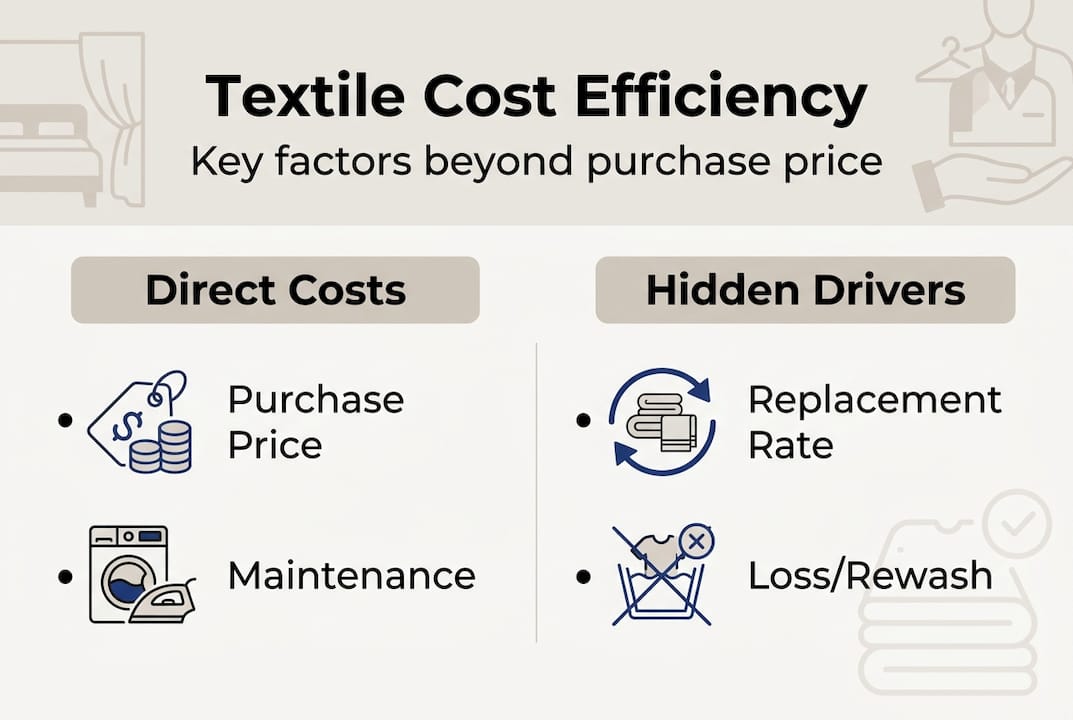
- Hidden drivers: Loss, rewash, and replacement frequency
- Efficiency in action: Supply chain realities for Albanian buyers
- Why ‘lowest price’ is the wrong goal for Albanian hospitality
- Next steps: Partner with experts for smarter textile efficiency
- Frequently asked questions
Key Takeaways
| Point | Details |
|---|---|
| Total cost over price | Textile cost efficiency means focusing on total cost of ownership, not just lowest price. |
| Operational hidden costs | Loss, rewash, and replacement cycles can dwarf purchase savings if not managed closely. |
| Local supply realities | Albania’s logistics, availability, and lead times define what efficiency is possible in practice. |
| Measure what matters | Track loss rates, replacements, and quality to drive meaningful savings and guest satisfaction. |
Defining textile cost efficiency: Beyond price per item
The hospitality industry is full of professionals who treat textile procurement like a commodity purchase. Find the lowest price, place the order, move on. This approach feels efficient but rarely is. Real efficiency requires a fundamentally different definition.
Textile cost efficiency in hospitality procurement is about achieving the lowest total cost for providing the required guest-facing textile quality and service level, rather than minimizing the purchase price alone. That distinction matters enormously in practice. A hotel buying towels at a lower price per unit but replacing them every six months instead of every two years is not saving money. It is spending more while delivering a worse experience.
To be precise, efficiency in textile procurement operates across three separate dimensions:
- Production cost efficiency: This concerns the manufacturing or sourcing cost of the textile itself, including fabric quality, thread count, weave structure, and production standard. A higher-grade cotton towel may cost more per unit but requires less chemical treatment and performs better under repeated industrial washing cycles.
- Operational cost efficiency: This covers the real-world usage costs, including laundry expenses, repair frequency, loss rate, and downtime when par stock runs low. These costs are rarely visible on a purchase order but show up clearly in monthly operational budgets.
- Commercial efficiency: This reflects the value a textile delivers to the guest experience and, by extension, to your reputation and revenue. A guest who notices worn, thin bed linens is a guest who leaves a lower review rating, or simply does not return.
Being explicit about what “efficiency” means, whether production cost, operational cost, or commercial value, is the first step any procurement manager must take before evaluating any textile supplier or product.
Here is a concrete example. Suppose a hotel purchases standard towels at 400 ALL per unit and they last 150 wash cycles. A better-quality towel at 600 ALL per unit lasts 300 wash cycles. The second towel costs 50% more upfront but delivers the same number of wash cycles at half the replacement frequency. Factor in the labor cost of managing more frequent inventory replacements, and the “cheaper” towel becomes the more expensive choice. This is the logic every Albanian hospitality buyer must internalize.
“The goal is not to spend less on textiles. The goal is to get more value from every ALL spent across the full lifecycle of each textile item.”
Pro Tip: Before approving any textile purchase, ask your operations team to calculate the expected cost per wash cycle, not just the cost per unit. That single number reveals more about true efficiency than any price list. You can also explore how leading hotels cut hotel textile costs through structured procurement decisions.
The true cost of textiles: Understanding total cost of ownership
Now that efficiency is defined, the next step is to look at what actually makes up the real cost of textiles. Most procurement managers track purchase price and, if they are thorough, shipping costs. But the full picture is considerably wider.
Structured costing that aggregates direct textile costs, such as fabric, trims, and labor, plus indirect and overhead costs like shipping, duties, and administrative time, determines the true unit cost. This structured approach, common in manufacturing and retail, is underused in Albanian hospitality procurement. Applying it reveals exactly where money is going and where it can be recovered.
Here is a five-step approach to mapping all cost elements for your hotel or restaurant:
- Identify direct costs. These include fabric or raw material cost, production labor, finishing processes, and any branding or customization added to the textile.
- Add import and logistics costs. For Albanian buyers, this means customs duties, freight charges, port handling fees, and any inland transportation costs. These can add 15 to 25 percent above the supplier’s quoted price depending on the country of origin.
- Include operational overhead. Factor in laundry water and energy consumption, detergent costs per cycle, and staff time allocated to textile handling, sorting, and folding.
- Account for loss and replacement. Every item that disappears from inventory or is retired early due to damage represents a real cost. These numbers must be tracked and included in any true cost calculation.
- Assess commercial impact. Quantify how textile quality affects guest satisfaction scores and repeat booking rates, even at a rough level. A one-point drop in cleanliness or comfort ratings translates directly into revenue risk.
The following comparison table illustrates how a “cheapest price” approach and a “lowest total cost” approach produce very different outcomes over a 12-month period for a 50-room hotel:
| Cost category | Cheapest price option | Lowest total cost option |
|---|---|---|
| Purchase price per unit | 380 ALL | 580 ALL |
| Expected lifespan (washes) | 120 | 280 |
| Replacements needed per year | 3 cycles | 1.5 cycles |
| Annual replacement spend | 1,140 ALL per unit | 870 ALL per unit |
| Rewash rate | 12% | 4% |
| Guest complaint rate | Higher | Lower |
| Effective annual cost per unit | ~1,420 ALL | ~960 ALL |
The numbers make the case clearly. The lower-priced option ends up costing roughly 48 percent more per unit annually once real operational factors are included. A solid hospitality textile procurement guide can help you build this kind of cost model for your specific property.
Hidden drivers: Loss, rewash, and replacement frequency
Once all cost elements are considered, it is crucial to understand what really causes textile spending to soar in daily hotel operations. Most managers are aware that towels go missing and linens wear out. Fewer understand the scale and the financial impact of these losses when left unmanaged.
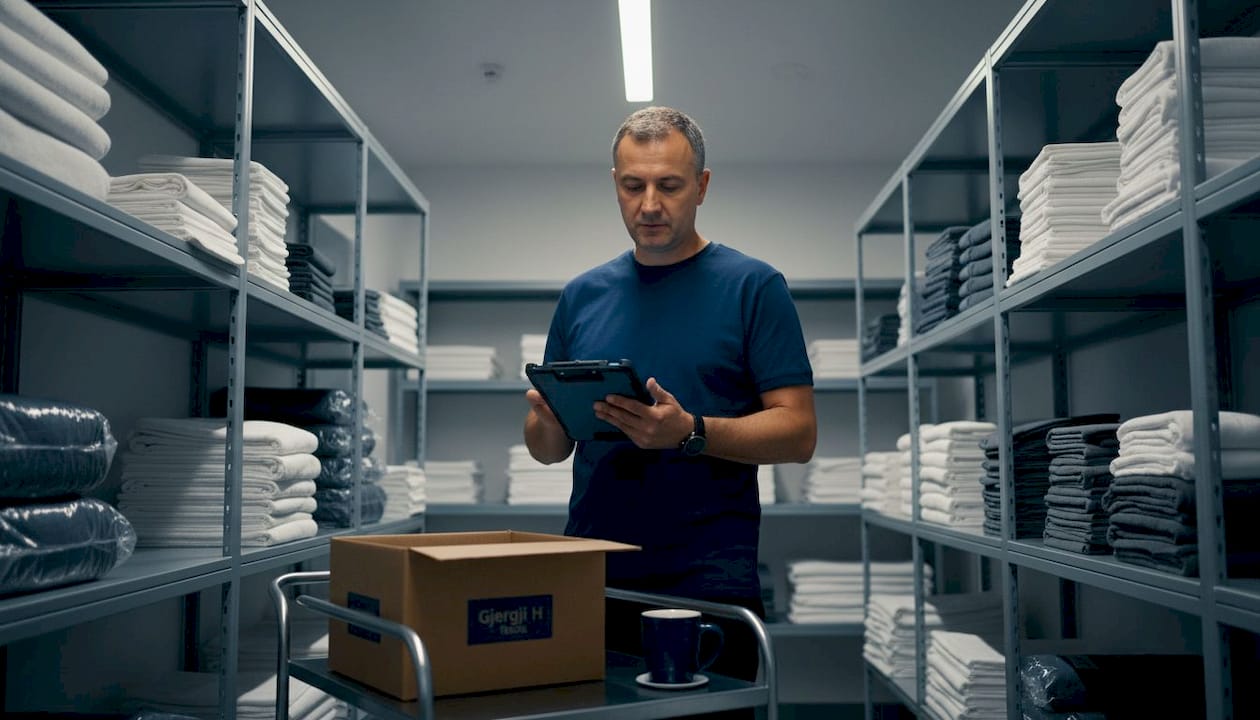
Textile cost efficiency in hotels is strongly affected by loss, rewash, and replacement frequency, not just fabric price, since these drivers multiply both procurement and operational costs. A towel that disappears from inventory is not just a lost towel. It is a replacement purchase, an administrative task, a gap in par stock, and potentially a guest-facing problem if shortage hits at the wrong time.
Common causes of inventory loss and quality degradation include:
- Guest removal: Towels and small linens are among the most commonly taken items in hotels worldwide. Properties without clear par stock tracking rarely know how bad this problem is until they do a full count.
- Improper handling: Industrial washing machines are powerful. Textiles that are not designed for high-temperature, high-rotation cycles degrade far faster than their specifications suggest when sorted or loaded incorrectly.
- Staining and irreversible damage: Food service environments are particularly harsh. Restaurant napkins and tablecloths face oils, sauces, and wine stains that require aggressive cleaning, which shortens their usable lifespan significantly.
- Poor storage conditions: Humidity, direct sunlight, and inadequate shelving contribute to fiber breakdown and mildew, often unseen until the textile is pulled from storage and found unusable.
Key benchmarks for procurement teams to connect to financial outcomes include replacement rate versus par stock, linen loss rate, rewash rate, and effective cost per wash cycle to quantify total cost of ownership accurately. European hotel benchmarks typically show rewash rates ranging from 3 to 8 percent for well-managed properties, while loss rates can climb above 10 percent annually in properties without active inventory controls.
The table below shows typical benchmark ranges across different operational tiers:
| Metric | Well-managed property | Average property | At-risk property |
|---|---|---|---|
| Annual loss rate | Below 5% | 5 to 12% | Above 12% |
| Rewash rate | Below 5% | 5 to 10% | Above 10% |
| Replacement cycle | Every 18 to 24 months | Every 12 to 18 months | Every 6 to 12 months |
| Effective cost per wash | Low | Moderate | High |
Pro Tip: Run a quarterly par stock reconciliation across all textile categories. Compare the count to purchase records and identify the loss rate by item type. This single practice often reveals enough waste to fund a meaningful upgrade in textile quality without increasing the total annual spend. You can structure this process more effectively with a defined textile maintenance workflow built for the Albanian hospitality context.
Efficiency in action: Supply chain realities for Albanian buyers
Operational realities and hidden costs mean efficiency must be pursued within the unique context of Albania’s supply environment. Albanian hospitality buyers face a set of procurement challenges that are distinct from those in Western European markets, and ignoring these realities when building an efficiency strategy leads to frustrating gaps between plan and execution.
For Albanian hospitality buyers, efficiency discussions should extend beyond unit textile price to include supply chain and logistics realities such as lead times, availability, and reliability, since these directly affect inventory levels and replacement urgency. A supplier quoting an excellent unit price from Pakistan or India with a 12-week lead time forces an Albanian buyer to maintain a much larger par stock than a local or regional supplier would require. That larger stock ties up working capital and increases storage costs, two factors that eat directly into any savings achieved on unit price.
The key supply chain pain points for Albanian hotel and restaurant buyers include:
- Long and unpredictable lead times from major textile-producing countries. Even when shipments are on schedule, Albanian customs processing can add unexpected delays.
- Customs and import duty complexity. Albanian import regulations and duties vary by product category and country of origin, making cost planning difficult when working with multiple overseas suppliers.
- Inconsistent quality across batches. A supplier who delivers excellent product in the first shipment may deliver a noticeably different quality in subsequent ones, particularly when dealing with manufacturers who serve many buyers simultaneously.
- Limited reactive capacity. When an Albanian hotel needs an emergency textile replenishment, international suppliers cannot respond quickly. Local or regionally integrated suppliers can.
“The lowest cost supplier is often the highest risk supplier. In Albania’s hospitality market, supply chain reliability is a form of cost efficiency that never appears on a price comparison sheet.”
Building efficiency-buffered procurement cycles is the practical answer. This means ordering ahead of need, maintaining a reliable minimum par stock buffer, and working with suppliers who have in-country inventory or fast regional access. The goal is to reduce the frequency and urgency of reactive purchases, which are always more expensive than planned ones. A well-structured step-by-step textile procurement process, combined with a clear textile distribution guide, gives procurement managers the framework to do this consistently.
Why ‘lowest price’ is the wrong goal for Albanian hospitality
After reviewing all operational and supply realities, it is worth stating something directly: chasing the lowest textile price is a strategy that hurts Albanian hospitality businesses more often than it helps them.
The short-term savings trap is real. A hotel that saves 20 percent on a linen purchase and then spends 40 percent more managing replacements, rewashes, and guest complaints has not achieved efficiency. It has created an ongoing problem that gets harder to solve with each budget cycle. We have seen this pattern repeat across Albanian properties of all sizes, from small city hotels to larger coastal resorts, and the story is consistently the same.
Local experience also shows that unreliable suppliers and poor-quality imports introduce unpredictable costs that no manager budgets for at the start of a season. A beachfront resort discovering mid-July that its towel inventory is 30 percent below par because a shipment was delayed has only expensive options available to it. None of those options are in the original procurement plan.
The right goal is not the lowest price. It is the best total value: reliable supply, consistent quality, and a cost structure that holds across the full year. Understanding why custom textiles and guest experience are linked helps reframe this decision correctly. When guests feel the quality of your linens, towels, and table settings, they are experiencing your brand. That experience has a real financial value that a lower invoice price cannot replace.
Pro Tip: When evaluating a new supplier, calculate the true cost over a 24-month horizon, not just the first order. Include expected replacement frequency, shipping reliability, and the cost of one supply disruption. That calculation almost always changes the decision.
Next steps: Partner with experts for smarter textile efficiency
Ready to put textile cost efficiency into practice? Understanding the theory is one thing. Building a procurement system that actually delivers reliable quality, controlled costs, and supply consistency in Albania requires the right partner, not just the right product.

Gjergji H Tekstil provides Albanian hotels and restaurants with access to wholesale textiles for hotels sourced from major producing countries, combined with in-country inventory and distribution that eliminates the lead time risk described above. Their team can also guide you through textile quality testing for hospitality to ensure every procurement decision is grounded in measurable standards. For properties ready to elevate their guest experience through tailored solutions, the case to invest in custom textiles is one their advisors have helped dozens of clients build successfully.
Frequently asked questions
What is textile cost efficiency in hospitality?
It means achieving the lowest total cost for guest-facing textiles while delivering the required quality and service level, incorporating purchase price, maintenance, laundry, and replacement costs together.
How can hotels in Albania measure textile cost efficiency?
By tracking replacement rate, rewash frequency, and loss rate alongside cost per wash cycle, hospitality managers can build a clear picture of true operational textile efficiency.
Why do hidden costs often exceed the price of textiles?
Loss, rewashing, and frequent replacements compound quickly in hotel operations, turning a low purchase price into a significantly higher annual spend than a more durable alternative would require.
What challenges affect textile procurement efficiency in Albania?
Supply chain delays, customs complexity, and unreliable suppliers force Albanian hotels to carry larger inventory buffers and respond reactively to shortages, both of which increase total procurement costs substantially.