


TL;DR:
- Consistent textile quality is crucial for guest satisfaction and operational efficiency.
- Proper supplier evaluation, clear specifications, and ongoing quality control reduce risks.
- Building strong, documented relationships with reliable regional suppliers ensures long-term procurement success.
Inconsistent linen quality, last-minute supply shortages, and guest complaints about worn towels are not minor inconveniences. They are operational failures with real revenue consequences. For procurement managers at Albanian hotels, sourcing textiles that hold up to industrial washing cycles while maintaining consistent guest-facing standards is one of the most demanding supply chain challenges you face. The good news is that a structured, step-by-step procurement process dramatically reduces these risks. This guide walks you through every stage, from defining specifications to monitoring supplier performance, so you can build a supply chain that keeps your property running smoothly.
Table of Contents
- Understanding hotel textile requirements
- Market research and supplier identification
- Requesting quotes and negotiating terms
- Quality control and supplier relationship monitoring
- The real secret to effective textile procurement in Albania
- Partner with local textile experts for hotel success
- Frequently asked questions
Key Takeaways
| Point | Details |
|---|---|
| Define clear requirements | Thoroughly specify fabric types, GSM, and certifications before supplier outreach for consistent results. |
| Audit and compare suppliers | Use checklists and comparison tables to evaluate suppliers’ capabilities and sustainability. |
| Negotiate total value | Consider payment terms, surcharges, and total landed cost, not just unit price. |
| Establish strong QC process | Implement multi-stage quality checks and document everything to avoid late surprises. |
| Prioritize supplier relationships | Building ongoing trust and feedback loops with suppliers safeguards quality for the long term. |
Understanding hotel textile requirements
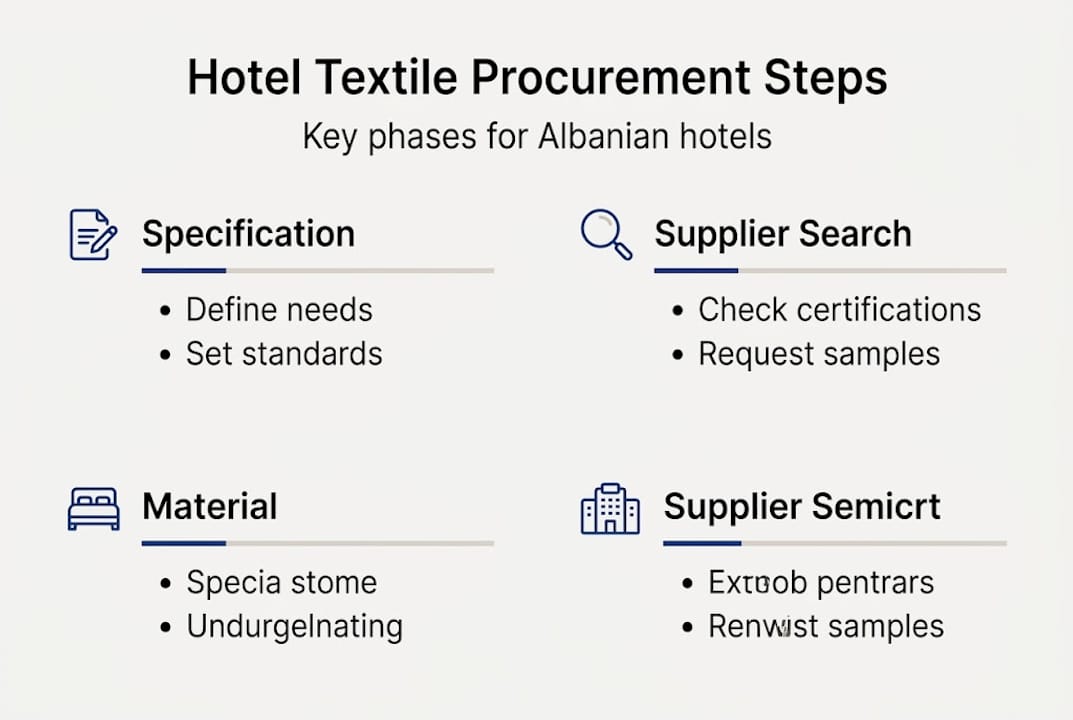
Every effective procurement process starts with a clear definition of what you actually need. Skipping this step is the single most common reason hotels end up with textiles that look acceptable on paper but fail within weeks of use. Textile procurement for hotels starts with defining methodology and fabric requirements, including type, GSM, and sustainability criteria.
GSM, or grams per square meter, is the weight measurement of a fabric. It directly affects how a textile feels, how long it lasts, and how it performs through repeated washing. A bath towel at 400 GSM feels noticeably lighter and less absorbent than one at 600 GSM. For hotel use, heavier GSM generally means greater durability, but it also means longer drying times and higher laundry costs. Matching GSM to your specific operational context matters.
Thread count is another commonly misunderstood metric. Higher thread count does not automatically mean better quality. A 300-thread-count sheet made from long-staple Egyptian cotton will outperform a 600-thread-count sheet made from short-staple blended fiber. What matters is the combination of fiber quality, weave structure, and finishing treatment.
For durability testing, two methods are essential to understand. The Martindale Test measures abrasion resistance by simulating rubbing cycles. A higher Martindale rating means the fabric holds up longer under friction, which is critical for upholstery, curtains, and high-contact surfaces. The 4-Point System is used to inspect fabric for defects before production or shipment, with a score of 40 points or fewer per 100 square yards considered a passing result.
| Specification | What it measures | Recommended hotel range |
|---|---|---|
| GSM (towels) | Weight and absorbency | 500 to 650 GSM |
| GSM (bed linens) | Weight and softness | 120 to 200 GSM |
| Thread count | Weave density | 200 to 400 (quality fiber) |
| Martindale rating | Abrasion resistance | 20,000 cycles minimum |
| GSM tolerance | Consistency per batch | Plus or minus 5% |
Key specification areas to define before contacting any supplier:
- Fabric type: cotton, polyester blend, microfiber, or linen
- GSM range with acceptable tolerance (plus or minus 5%)
- Colorfastness rating for industrial washing
- Sustainability certifications required
- Intended use: bed linens, towels, curtains, uniforms
A common mistake is over-specifying for low-use items and under-specifying for high-turnover ones. Corridor curtains and pool towels have very different durability demands. Align your specs with actual usage frequency. When defining procurement needs, always map each textile category to its operational context first.
Pro Tip: Build a simple spec sheet template for each textile category. This forces internal alignment before you approach suppliers and gives you a consistent baseline for comparing quotes.
Market research and supplier identification
Once your specifications are locked in, the next step is finding suppliers who can actually deliver to those standards. This is where many procurement managers lose time by contacting too many suppliers too early or by relying on price lists alone.

The global hotel textile market is projected to reach USD 12.8 billion by 2026, with growing emphasis on Tier 2 suppliers for their balance of quality and sustainability responsiveness. Understanding supplier tiers helps you make smarter sourcing decisions.
| Supplier type | Strengths | Weaknesses |
|---|---|---|
| Tier 1 (large global) | Scale, wide range, brand recognition | Less flexible, higher MOQ, slower response |
| Tier 2 (regional/specialized) | Quality focus, faster communication, customization | Smaller capacity, limited certifications sometimes |
| Local distributors | Fast delivery, lower logistics cost | Limited product range, may not manufacture directly |
A structured approach to evaluating textile suppliers follows these steps:
- Issue a Request for Information (RFI) to gather supplier capabilities, production capacity, and lead times
- Request physical samples matched to your spec sheet for each textile category
- Verify certifications: GRS (Global Recycled Standard), OEKO-TEX, and CE compliance are the baseline
- Conduct a site visit or request a third-party audit for shortlisted suppliers
- Confirm minimum order quantities (MOQ) and standard lead times in writing
- Check references from existing hospitality clients in similar markets
The supplier audit checklist should always include certification verification, sample evaluation, site visit or audit report, MOQ terms, and confirmed delivery schedules. Skipping any of these steps introduces risk that shows up later as quality failures or supply gaps.
For Albanian hotels, the regional sourcing landscape includes suppliers from Italy, Turkey, Greece, and further afield from China, India, and Pakistan. Each region carries different cost structures, lead times, and quality profiles. Italian suppliers tend to offer premium quality at higher price points. Turkish and Greek suppliers often provide a strong middle ground. Asian suppliers offer volume pricing but require more rigorous QC oversight.
When sourcing sustainable hotel textiles, prioritize suppliers who can provide documented certification rather than just marketing claims.
Pro Tip: Mix one Tier 1 supplier for your core high-volume items with one or two Tier 2 suppliers for specialized or custom needs. This gives you pricing leverage and supply security without over-relying on a single source.
Requesting quotes and negotiating terms
With a shortlist of qualified suppliers, the focus shifts to pricing and contract terms. A well-structured Request for Quotation (RFQ) is the tool that separates disciplined procurement from reactive purchasing.
Your RFQ should specify exact quantities, product specs, delivery locations, required certifications, and packaging requirements. The goal is to get apples-to-apples cost breakdowns that you can actually compare. Vague RFQs produce vague quotes, and vague quotes lead to budget surprises.
Key negotiation priorities when reviewing quotes:
- Unit price versus total landed cost (freight, duties, and handling included)
- Payment terms: Net 30 is standard; letters of credit (LC) protect both parties on larger orders
- Sample approval clauses: no bulk production should begin without signed sample sign-off
- Surcharge waivers: raw material surcharges are common; negotiate caps or waiver conditions
- Delay penalties: define what happens if delivery misses the agreed date
The total cost of ownership (TCO) for hotel textiles includes the landed cost plus a buffer of 3 to 5% to account for market volatility, currency fluctuation, and unexpected logistics costs. Never budget based on quoted unit price alone.
“The best procurement contracts are not the cheapest ones. They are the ones where both parties understand exactly what is expected, what happens when things go wrong, and how disputes get resolved before they become crises.”
Red flags to watch for in quotes and contracts include vague delivery windows, no mention of defect resolution procedures, and payment terms that require full upfront payment with no milestone structure. A supplier unwilling to negotiate bulk purchasing strategies or provide sample approval clauses is a supplier worth reconsidering.
Always request itemized cost breakdowns. If a supplier bundles everything into a single per-unit price, ask them to separate raw material cost, production cost, and logistics cost. This transparency protects you during future renegotiations.
Quality control and supplier relationship monitoring
Signing a contract is not the end of the procurement process. It is the beginning of the operational phase, and this is where many hotels lose the quality they negotiated for.
Effective quality control operates at multiple stages. Multi-stage QC processes, including pre-production, in-line, and pre-shipment inspections using the 4-Point System, prevent late-stage defects from reaching your property.
Key QC checkpoints to implement:
- Pre-production meeting: confirm specs, approved samples, and production timeline with the supplier
- In-line inspection: check fabric rolls and cut pieces during production for GSM, color, and weave consistency
- Pre-shipment inspection: conduct a 4-Point System evaluation on finished goods before they leave the factory
- Receiving inspection: spot-check every delivery at your property against the approved sample
- Post-use review: track how textiles perform after 20, 50, and 100 wash cycles
Building a strong supplier relationship requires more than just placing orders. Schedule quarterly performance reviews. Share your occupancy forecasts so suppliers can plan production. Create a clear escalation policy: who contacts whom when there is a quality issue, and what the resolution timeline is.
“Skipping quality control to save time is one of the most expensive decisions a hotel can make. A single defective shipment of 500 towels costs far more in guest complaints and replacement orders than a thorough pre-shipment inspection ever would.”
Document everything. Keep records of approved samples, inspection reports, delivery performance, and defect rates. This documentation becomes your negotiating leverage in future contract cycles and your evidence base if disputes arise.
Pro Tip: Maintain a Just-in-Case inventory buffer of 10 to 15% above your standard par level for high-turnover items like towels and bed linens. Albanian supply chains can face seasonal disruptions, and running out of guest-facing textiles is never acceptable. Review fabric testing standards regularly to keep your QC criteria current, and use structured supplier management tips to formalize your monitoring process.
The real secret to effective textile procurement in Albania
After more than 30 years of working with hotels, resorts, and hospitality operators across Albania, one pattern stands out clearly. The hotels that consistently deliver excellent guest experiences are not necessarily the ones with the biggest procurement budgets. They are the ones with the most disciplined supplier relationships.
Price-only procurement strategies fail because they ignore the value of trust, responsiveness, and institutional knowledge. A supplier who knows your property, understands your seasonal demand cycles, and has a track record of resolving issues quickly is worth more than a marginally cheaper alternative who treats your account as just another order.
Local and regional Tier 2 suppliers, when properly audited, often outperform global names in practical responsiveness. They can adjust production runs faster, communicate more directly, and resolve quality issues without the bureaucracy of large organizations.
The overlooked gap in most Albanian hotel procurement is documentation. Most managers rely on informal agreements and personal relationships, which work until they do not. Formalizing sample approvals, QC checkpoints, and escalation procedures does not slow the process down. It protects the relationship by removing ambiguity. A clear manager’s procurement perspective always includes written processes, not just verbal commitments.
Partner with local textile experts for hotel success
Procurement does not have to be a process you navigate alone. Gjergji H Tekstil has been supplying Albanian hotels and hospitality businesses since 1994, with a supply chain that spans import, production, and direct distribution.

Whether you are sourcing wholesale hotel textiles for a full property refresh or need quality fabric testing support before committing to a new supplier, the team at Gjergji H Tekstil brings the operational depth and regional knowledge to make your procurement process faster and more reliable. For properties that want tailored solutions, explore custom hotel textiles designed specifically for your brand standards and guest expectations. Reach out to discuss your next procurement cycle.
Frequently asked questions
What is the 4-Point System in hotel textile procurement?
The 4-Point System is a fabric inspection method where defects are scored by severity, and a total of 40 points or fewer per 100 square yards is considered a passing result. It is used at pre-shipment stage to catch defects before goods reach your property.
Which certifications are most important for Albanian hotel textile suppliers?
The baseline certifications to request are GRS (Global Recycled Standard), OEKO-TEX, and CE compliance, which confirm that materials are sustainable, chemically safe, and meet regulatory standards.
How do you compare Tier 1 and Tier 2 hotel textile suppliers?
Tier 1 suppliers offer scale and product range, but Tier 2 suppliers often deliver better quality-to-cost ratios and faster issue resolution, making them a strong fit for Albanian hotel procurement needs.
What are the key negotiation points for textile procurement contracts?
Always clarify payment terms and TCO including Net 30 or letter of credit options, sample approval requirements, surcharge caps, delay penalties, and total landed cost with a 3 to 5% buffer built in.
What ongoing monitoring is needed after contracting a textile supplier?
Implement multi-stage performance monitoring that includes regular QC checks, documented delivery performance, defect rate tracking, and quarterly supplier reviews to maintain consistent quality over time.