

TL;DR:
- Certified textiles ensure safety, durability, and consistency, leading to better guest satisfaction.
- Investing in certified textiles reduces operational costs through longer lifespan and lower replacement frequency.
- Proper sourcing and verification of certifications enhance quality, safety, and sustainability in hospitality textiles.
Many hospitality professionals assume that a white towel is a white towel, and that thread count or fabric weight are the only variables worth tracking. That assumption costs hotels real money and real guests. Certified textiles are not just a marketing label. They represent a documented standard of safety, durability, and performance that directly shapes how guests feel in your rooms, at your tables, and throughout your property. This guide breaks down what textile certification actually means, how it connects to guest satisfaction and operational costs, and what practical steps you can take to source and verify certified textiles for your hotel or resort.
Table of Contents
- What are certified textiles and why do they matter?
- How certified textiles elevate guest satisfaction
- Cost, longevity, and sustainability benefits of certified textiles
- How to source and verify certified textiles for hotels and resorts
- Our take: what most hospitality managers miss about certified textiles
- Ready to elevate your hospitality textiles?
- Frequently asked questions
Key Takeaways
| Point | Details |
|---|---|
| Certification protects reputation | Choosing certified textiles ensures guest safety, hygiene, and positive reviews. |
| Longevity reduces costs | Certified textiles outlast alternatives, saving money on replacements and maintenance. |
| Sustainability drives value | Certified textiles support eco-friendly operations and align with modern guest expectations. |
| Supplier verification is essential | Always request certification documents and test samples to guarantee quality. |
What are certified textiles and why do they matter?
Certified textiles are fabrics and textile products that have been independently tested and verified against established standards for safety, durability, and often sustainability. The certification is not self-declared by the manufacturer. It is issued by a recognized third-party body after rigorous testing of the material’s composition, production process, and performance under real-use conditions.
Several certifications are widely recognized in the hospitality sector. Oeko-Tex Standard 100 tests for harmful substances in every component of a textile, from thread to dye to finishing agents. This matters directly in hotel environments where guests have prolonged skin contact with bed linens and towels. ISO 9001 certifies the quality management system of the manufacturer, meaning consistent production standards across every batch you order. GOTS (Global Organic Textile Standard) covers organic fiber content and responsible processing, which is increasingly relevant for hotels targeting eco-conscious travelers. Each certification answers a specific operational question: Is this fabric safe? Is it consistently made? Is it environmentally responsible?
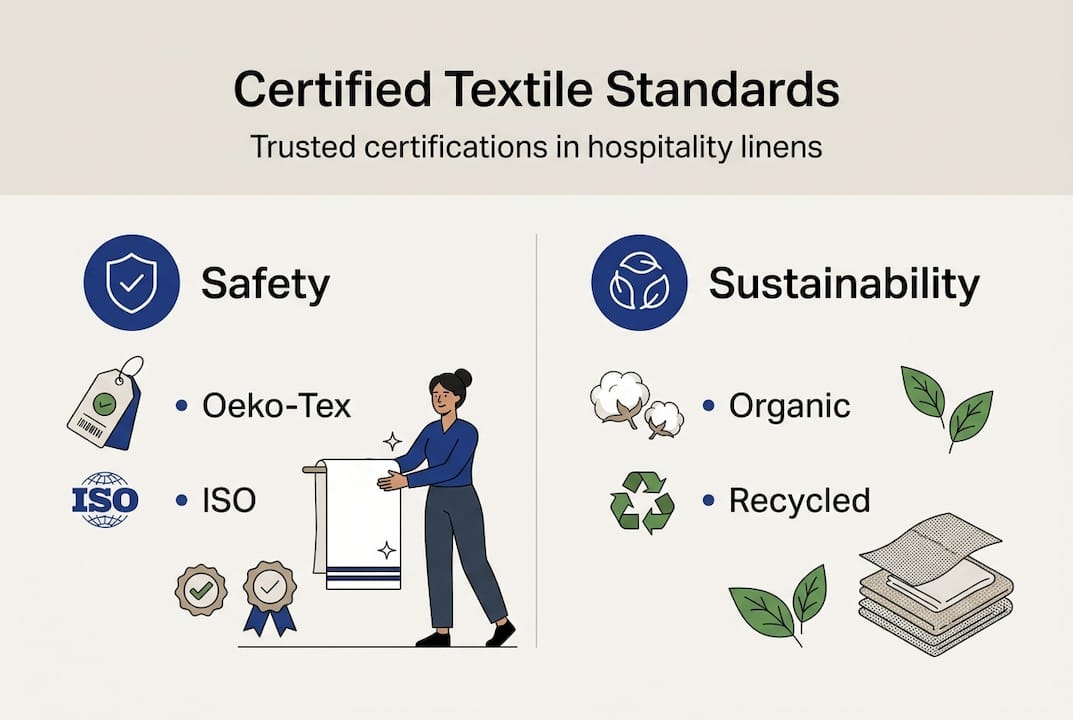
As confirmed through fabric testing for hotels, certified textiles are tested for safety, durability, and sustainability, which means you are not relying on a supplier’s word alone. You have documented proof.
For hospitality businesses, the benefits of certification extend beyond compliance:
- Guest safety: Certified fabrics contain no harmful residues that could cause skin reactions or allergic responses.
- Hygiene performance: Tested fabrics maintain structural integrity through industrial washing cycles, preserving their barrier and absorbency properties.
- Consistency: Certification ensures every delivery meets the same standard, eliminating the quality variance that creates guest complaints.
- Brand protection: A documented supply chain protects you in the event of a guest complaint or regulatory inquiry.
When you source through hotel textile sourcing channels that prioritize certified products, you are building a quality control layer into your operations, not just buying fabric.
How certified textiles elevate guest satisfaction
Understanding certification is the groundwork, but how does it really affect what guests experience? Let’s explore the impact on satisfaction and comfort.
Guest satisfaction in hotels is shaped by dozens of micro-experiences, and textiles are involved in nearly all of them. The weight of a towel, the smoothness of a pillowcase, the crispness of a tablecloth in your restaurant. These details register immediately, even when guests cannot articulate why they feel comfortable or uncomfortable. Certified textiles are engineered to perform consistently in exactly these moments.
Certified textiles contribute to positive guest reviews and overall reputation, and the reason is straightforward: certified fabrics hold their appearance and feel longer. A non-certified towel may feel acceptable on day one but pill, thin, and discolor after 40 wash cycles. A certified towel maintains its texture and absorbency well past 100 cycles. Guests who return to your property notice that consistency, even if they never consciously think about it.
The guest does not review your textile certification. They review how they felt. Certification is the mechanism that ensures they feel well, every single time.
The visual impact of textiles is equally significant. Certified fabrics resist color fading and shrinkage, which means your rooms look uniform and professionally maintained. Non-certified alternatives often show uneven fading or mismatched shades after repeated washing, creating a visual inconsistency that guests associate with poor maintenance.
Certified vs. non-certified textiles: a practical comparison
| Feature | Certified textiles | Non-certified textiles |
|---|---|---|
| Wash cycle durability | 100+ cycles | 30 to 60 cycles |
| Color retention | High | Variable |
| Skin safety documentation | Verified | Unverified |
| Consistency across batches | Guaranteed | Not guaranteed |
| Guest complaint risk | Low | Higher |
As further supported by custom hotel textiles research, custom and certified textiles boost comfort, hygiene, and guest satisfaction in measurable ways. Hotels that invest in certified products report fewer linen-related complaints and stronger scores in cleanliness categories on review platforms.
Pro Tip: The most common mistake hotels make is purchasing textiles based on price per unit without factoring in wash cycle lifespan. A cheaper, non-certified sheet that lasts 40 cycles costs far more per use than a certified sheet lasting 120 cycles. Always calculate cost per wash cycle, not cost per piece.
For practical guidance on making the right selections, the hotel textile selection tips available from experienced suppliers can help you build a specification sheet tailored to your property’s operational needs.
Cost, longevity, and sustainability benefits of certified textiles
Now that we know certified textiles impact satisfaction, let’s look at their economic and environmental advantages for hospitality businesses.
The upfront price of certified textiles is often higher than non-certified alternatives. That fact stops many procurement managers from moving forward. But the total cost of ownership tells a very different story. Certified textiles last longer and result in lower maintenance costs, which means the investment pays back through reduced replacement frequency, lower laundry damage rates, and fewer emergency orders.
Consider a 60-room hotel replacing bed linens. If non-certified linens require full replacement every 18 months and certified linens last 42 months, the certified option eliminates at least one full procurement cycle over a three-year period. That is a significant operational saving, especially when you factor in the administrative cost of sourcing, ordering, and receiving new stock.
Lifecycle cost comparison: certified vs. non-certified linens
| Cost factor | Certified | Non-certified |
|---|---|---|
| Average lifespan | 36 to 48 months | 12 to 18 months |
| Replacement cycles (3 years) | 1 | 2 to 3 |
| Laundry damage rate | Low | Higher |
| Total cost per room (3 years) | Lower | Higher |
Sustainability certifications add another layer of value. Eco-labeled textiles often use less water and fewer chemicals in production, which aligns with the growing guest expectation for responsible hospitality. Properties that can document their textile sourcing as environmentally responsible gain a credible marketing advantage, particularly with corporate travel clients and international guests.
Here is a practical checklist for evaluating textile longevity before you commit to a supplier:
- Request wash cycle test data from the supplier, specifically results at 50, 100, and 150 cycles.
- Ask for tensile strength and abrasion resistance reports, which measure how the fabric holds up under friction.
- Review shrinkage rate documentation to ensure sizing remains consistent after industrial washing.
- Check for colorfastness ratings, which indicate how well dyes hold under repeated laundering.
- Verify that the certification covers the specific product category you are purchasing, not just the manufacturer’s general operations.
Pro Tip: Build a textile maintenance workflow that tracks the wash cycle count for each linen batch. This data helps you predict replacement timelines accurately and avoid emergency procurement, which is always more expensive.
For a structured approach to the full procurement process, the textile procurement steps outlined for Albanian hotels provide a clear operational framework that applies across the region.
How to source and verify certified textiles for hotels and resorts
Equipped with an understanding of the value and cost benefits, let’s dive into the practical steps for sourcing and verifying certified textiles.
Sourcing certified textiles is not complicated, but it requires discipline. The most important principle is simple: do not accept a supplier’s claim of certification without documented proof. As confirmed in hospitality textile procurement guidance, working with verified suppliers ensures consistent quality and certification across your entire linen inventory.
Follow these steps when qualifying a new textile supplier:
- Request the supplier’s current certification documents, including the issuing body’s name, certificate number, and expiry date.
- Cross-check the certificate on the issuing body’s official website. Oeko-Tex, for example, maintains a public database where you can verify any certificate number.
- Ask for product-specific test reports, not just company-level certifications. A manufacturer can hold an ISO quality certificate while producing individual products that do not meet your performance standards.
- Request physical samples and submit them for independent lab testing if your procurement volume justifies the cost.
- Review the supplier’s batch consistency record. Ask how they handle quality deviations between orders.
Common pitfalls to avoid during procurement:
- Accepting verbal assurances without written documentation.
- Ordering based on samples without confirming production batches will match.
- Ignoring expiry dates on certifications, which may have lapsed since the supplier last updated their files.
- Skipping sample washing tests before approving a large order.
Pro Tip: Keep a supplier certification file with copies of all documents, organized by product category and renewal date. When audits or regulatory checks occur, this file keeps your procurement process defensible and your operations running smoothly.
For hotels managing large inventories, the hotels textile wholesale channel provides access to pre-verified certified products, reducing the verification burden on your internal team. Pairing this with the textile procurement steps framework gives you a repeatable process that scales with your property.
Our take: what most hospitality managers miss about certified textiles
Having outlined sourcing steps, let’s offer a perspective rooted in practical experience and regional expertise.
After working with hotels across Albania and the broader Balkans region, one pattern stands out clearly. Most managers evaluate textile purchases as a cost line, not a brand investment. They focus on the invoice and miss the downstream impact on guest loyalty, staff efficiency, and reputation.
Here is what the data from high-performing regional hotels actually shows. Properties that standardize on certified textiles report fewer linen-related housekeeping issues, which means staff spend less time managing complaints and more time on productive tasks. That is a real operational gain that never appears on a textile invoice.
Certification is also a brand signal. When a guest sleeps on a properly certified, consistently maintained linen set, they associate that quality with your property’s overall standard. That association drives return bookings and word-of-mouth referrals. The ROI is real, even if it is indirect.
Our contrarian advice: stop optimizing for the lowest unit price. Start optimizing for the lowest cost per guest experience delivered. For hospitality textile advisory that connects procurement decisions to guest experience outcomes, the right partner makes that calculation straightforward.
Ready to elevate your hospitality textiles?
With a clear understanding of certified textiles and sourcing strategies, here’s how Gjergji H Tekstil supports your next steps.
Gjergji H Tekstil has supplied certified hospitality textiles to properties including Meliá, Marriott, and Sheraton, building a supply chain that prioritizes documented quality at every stage. Whether you are equipping a new property or upgrading your current linen inventory, the right certified products are available through a single, reliable source.

Explore the full range of wholesale hotel textiles to find certified bed linens, towels, and room textiles suited to your property’s specifications. Review the hospitality procurement guide to structure your sourcing process, or browse expert hotel textile tips to refine your selection criteria. For direct assistance, contact our team to discuss your property’s specific requirements and volume needs.
Frequently asked questions
What certifications should hospitality textiles have?
Oeko-Tex, ISO, and organic certifications are most recognized for safety and sustainability in hospitality textiles. These standards confirm that certified textiles are tested for safety, durability, and sustainability before reaching your property.
How do certified textiles affect guest reviews?
Certified textiles improve comfort and hygiene, directly leading to better guest reviews and higher satisfaction scores. Properties that invest in certified products see measurable improvements because certified textiles contribute to positive guest reviews and overall reputation.
Do certified textiles cost more up front?
They may cost more initially, but certified textiles typically offer longer lifespans and lower total costs due to fewer replacements. The evidence is clear: certified textiles last longer and result in lower maintenance costs over the full operational lifecycle.
How can I confirm suppliers’ certifications?
Ask suppliers for documented certifications and perform sample testing to verify authenticity and quality. Working with verified suppliers ensures consistent quality and certification, and cross-checking certificates on the issuing body’s public database adds another layer of assurance.
Do certified textiles help reduce environmental impact?
Yes, certified textiles often meet sustainability standards, resulting in lower waste and eco-friendly operations. Because certified textiles are tested for sustainability alongside safety and durability, choosing them supports your property’s environmental commitments without sacrificing performance.