


TL;DR:
- Textile advisory enhances durability, reduces costs, and improves guest experience through strategic management.
- It covers sourcing, testing, compliance, and supply chain optimization tailored to hotel needs.
- Most Albanian hotels rely on supplier advice, but independent and international consultants provide more strategic support.
Most hotel managers in Albania treat linen procurement as a simple purchasing task. Order towels, restock pillowcases, replace what wears out. But this approach quietly drains budgets. Hotels that lack a systematic textile strategy often overspend on replacements, miss durability benchmarks, and deliver inconsistent guest experiences. Textile advisory refers to specialized consulting services that optimize textile operations, sourcing, quality control, compliance, and supply chain management. It is not just about buying linens. It is about building a strategy that protects your investment, satisfies guests, and keeps operations running without friction.
Table of Contents
- What is textile advisory? Definitions and key functions
- How textile advisory impacts hospitality operations
- Advisory vs. agents and suppliers: How Albanian hotels approach textile strategy
- Sustainability and compliance: Emerging priorities in hospitality textiles
- Why smart textile advisory is a game-changer for Albanian hospitality
- Discover solutions with Gjergji H Tekstil
- Frequently asked questions
Key Takeaways
| Point | Details |
|---|---|
| Strategic textile advisory | Expert advice transforms hotel linen strategies for quality, cost, and guest experience. |
| Operational savings | Certified textiles and RFID tracking cut replacements and losses, saving thousands annually. |
| Supplier partnerships | Local suppliers often deliver advisory services, especially in Albania, filling the consulting gap. |
| Sustainability compliance | Meeting standards like OEKO-TEX and GOTS boosts brand reputation and aligns with EU requirements. |
What is textile advisory? Definitions and key functions
Textile advisory is far more than procurement. At its core, it is a structured consulting approach that helps hospitality businesses make smarter decisions about every textile touchpoint in their operation. According to specialized consulting services, the scope covers sourcing, quality control, compliance, and supply chain optimization simultaneously.
For hotels and restaurants, this translates into concrete functions. A textile advisor audits your current inventory, identifies waste and underperformance, and builds a sourcing strategy aligned with your operational volume and guest expectations. They develop tech packs, which are detailed product specifications that manufacturers must meet before delivery. They also run performance testing protocols covering abrasion resistance, colorfastness, and wash cycle durability.
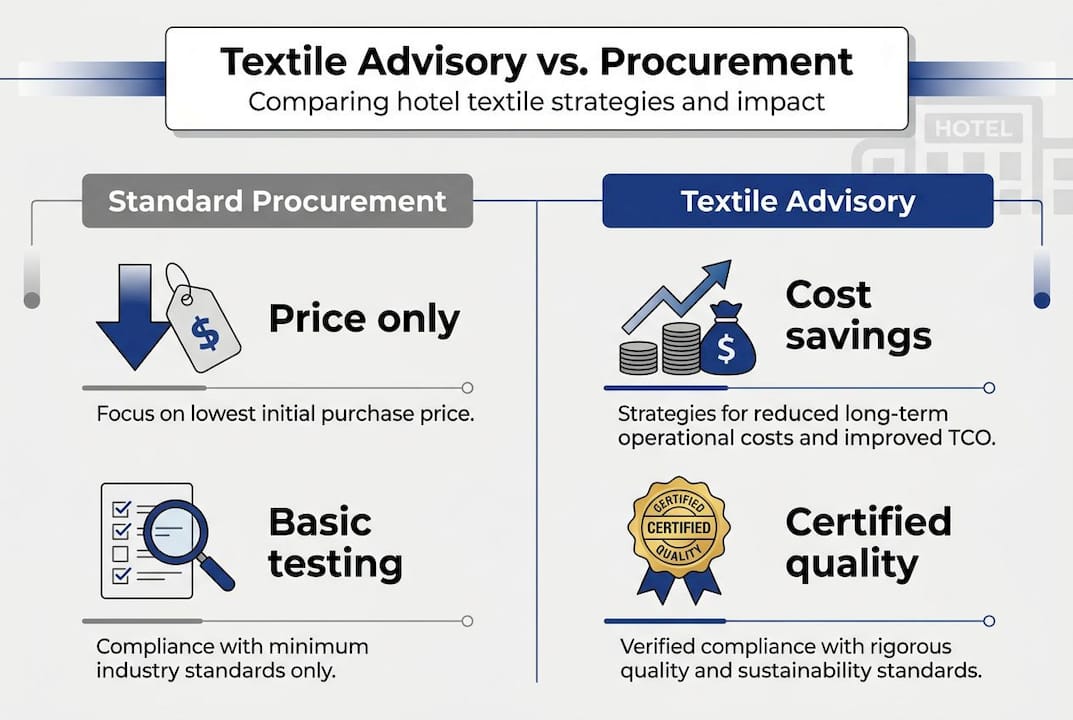
Here is a quick comparison of what textile advisory covers versus standard procurement:
| Function | Standard procurement | Textile advisory |
|---|---|---|
| Sourcing | Price-based selection | Quality and lifecycle analysis |
| Testing | Rarely performed | Systematic performance benchmarks |
| Compliance | Often overlooked | OEKO-TEX, GOTS, EU standards |
| Inventory | Reactive restocking | Predictive, data-driven planning |
| Cost focus | Unit price | Total cost of ownership |
The advisory approach also covers hotel textile requirements specific to your property size, guest profile, and washing infrastructure. A 200-room hotel has fundamentally different needs than a boutique restaurant. Advisory services account for that.
Key functions you should expect from a textile advisory engagement include:
- Textile audits: Evaluating current stock performance, loss rates, and replacement cycles
- Strategic sourcing: Identifying suppliers with verified quality and compliance credentials
- Tech pack development: Creating precise product specifications for manufacturers
- Performance testing: Simulating real-use conditions before bulk purchasing
- Supply chain optimization: Reducing lead times and improving delivery reliability
As textile manufacturing consulting professionals note, cost engineering and benchmarking are also central to advisory work. This means you are not just buying better products. You are building a system that performs consistently. For textile advisory tips tailored to hospitality environments, the starting point is always understanding total cost, not just the invoice price.
“Hospitality textiles are not a commodity. They are a service delivery tool. Every thread count decision affects the guest experience.”
How textile advisory impacts hospitality operations
Understanding the functions is one thing. Seeing the measurable impact is what convinces procurement managers to change their approach.
Start with durability. Certified textiles last 20-30% longer because they are tested against 100 to 150 industrial wash cycles before deployment. This directly reduces replacement frequency, which is one of the largest hidden costs in hotel linen management. For a mid-size hotel with 100 rooms, that difference can represent tens of thousands of dollars annually.
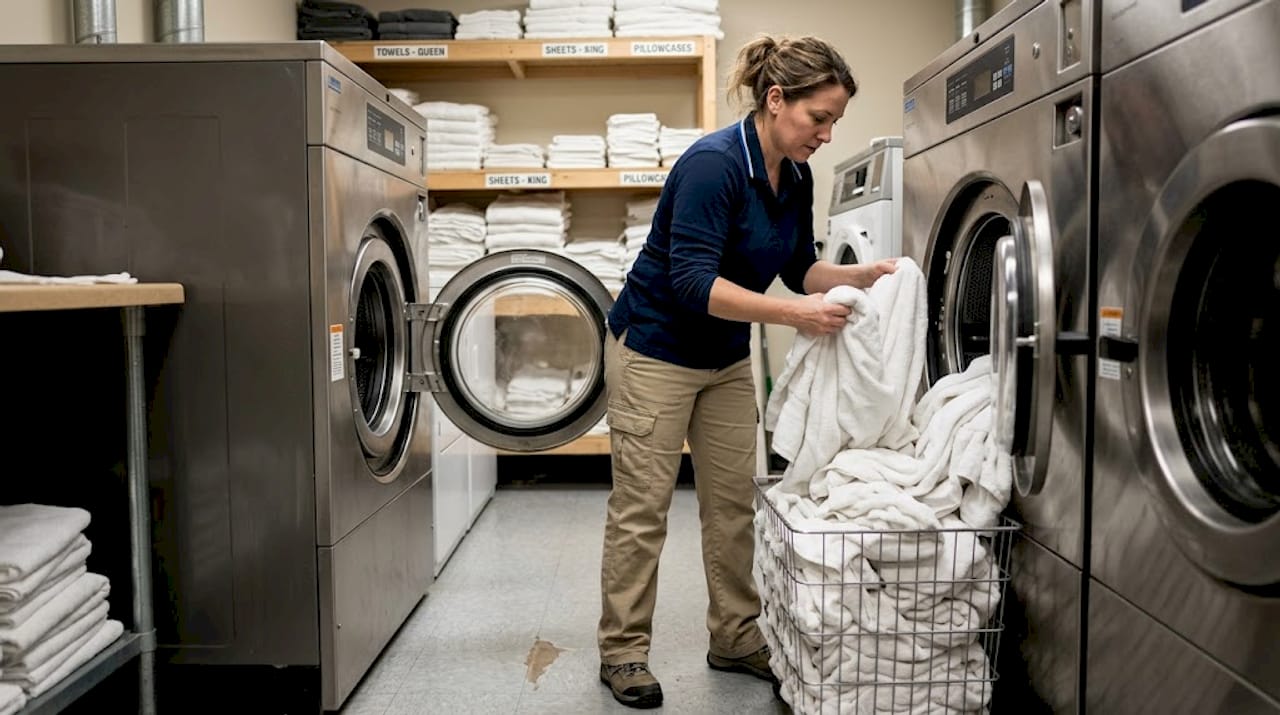
Then consider linen loss. It is a problem most managers underestimate. RFID implementation reduced linen loss from 15% to 3 to 5%, saving $180,000 per year for a 150-room hotel. That is not a marginal improvement. That is a structural change in how a hotel manages its textile assets.
Here is how performance testing types connect to operational savings:
| Test type | What it measures | Operational benefit |
|---|---|---|
| Abrasion resistance | Fabric wear under friction | Longer sheet and towel lifespan |
| Colorfastness | Color retention after washing | Consistent visual standards |
| Wash cycle simulation | Durability over repeated laundering | Fewer replacements, lower cost |
| Shrinkage testing | Dimensional stability | Predictable fit and presentation |
Advisory-driven textile fabric testing gives you data before you commit to a bulk order. Without it, you are making expensive decisions based on samples and sales pitches.
The impact on guest experience is equally real. Guests notice worn towels, pilling pillowcases, and faded tablecloths. These details signal neglect. Hotels using certified, durability-tested textiles report fewer guest complaints related to room presentation and bedding comfort.
For linen workflow optimization, advisory also improves how textiles move through your operation, from laundry to storage to room assignment. Smarter workflows reduce labor time and minimize damage during handling.
Pro Tip: When evaluating textile suppliers, always ask for total cost of ownership data, not just unit price. A cheaper towel that lasts 40 wash cycles costs more per use than a premium towel rated for 150 cycles. The math is straightforward once you run it.
For maintenance workflow tips specific to Albanian hotel operations, the focus should be on aligning washing protocols with the durability ratings of your chosen textiles.
Advisory vs. agents and suppliers: How Albanian hotels approach textile strategy
With impact clarified, many managers wonder whom to trust for textile expertise in Albania. The answer requires understanding three distinct roles.
A textile consultant provides strategic, long-term advice. Their goal is your profitability and operational efficiency. They have no direct financial interest in which specific products you buy. A textile agent facilitates buying and selling. They earn through transactions, which can create bias toward higher-margin products. A supplier manufactures or distributes products and may offer informal advisory as part of the sales relationship.
No dedicated textile advisory firms have been identified operating in Albania as standalone businesses. Local textile firms serve the hospitality market, but advisory typically comes embedded within supplier relationships or through international consultants engaged by larger hotel groups.
This is the practical reality for Albanian hospitality managers. You are likely receiving advisory from your supplier. That is not inherently a problem, but it requires a more careful evaluation process on your part.
Here is how to compare your options:
| Advisor type | Primary motivation | Best for |
|---|---|---|
| Independent consultant | Your profitability | Complex, large-scale operations |
| Supplier-embedded advisory | Product sales | Mid-size hotels with trusted partners |
| International consultant | Compliance and standards | EU-aligned procurement programs |
When working with supplier-led advisory, verify these factors before committing to bulk textile imports:
- EU-compliant certifications: Ask for documentation, not just claims
- In-house testing capabilities: Can they show you test results for specific products?
- Product lifecycle evidence: How long do their products perform under real hotel conditions?
- References from comparable operations: Have they supplied properties similar to yours?
The manager’s procurement guide approach recommends treating supplier advisory as a starting point, not a final answer. Cross-reference recommendations with EU-compliant certifications and independent performance data when possible.
Pro Tip: Build long-term partnerships with suppliers who offer genuine advisory, not just transactional sales. A supplier invested in your operational success will proactively flag product improvements, alert you to supply chain changes, and help you plan seasonal inventory. That relationship has real financial value. Explore custom textile solutions as part of a partnership-oriented sourcing strategy.
Sustainability and compliance: Emerging priorities in hospitality textiles
Beyond practical concerns, sustainability and compliance are reshaping what good textile advisory looks like in 2026.
The most relevant standards for Albanian hotels seeking EU market alignment are:
- OEKO-TEX Standard 100: Tests for harmful substances in textiles at every production stage
- GOTS (Global Organic Textile Standard): Covers organic fiber content and responsible processing
- Recycled polyester certifications: Verify post-consumer content claims for blended fabrics
- PEFCR (Product Environmental Footprint Category Rules): An emerging EU framework measuring full lifecycle environmental impact
Textile advisory in hospitality now routinely includes sustainability compliance alongside performance testing and inventory management. These are not separate workstreams. They are integrated.
Why does this matter for your operation specifically? Because certified textiles do not just satisfy regulatory requirements. They tend to last longer, which reinforces the durability argument. And they give your property a credible sustainability story that resonates with guests, particularly international travelers who expect EU-level standards.
The debate in the industry is real. Some operators prioritize sustainability certifications like GOTS and recycled blends for branding purposes. Others focus purely on durability and cost, preferring performance-tested blends over pure cotton. The emerging consensus is that certified durability is becoming the baseline standard, and sustainability is the differentiator above that baseline.
For Albanian hotels, the practical entry point is OEKO-TEX certification. It is widely available, verifiable, and recognized across EU markets. GOTS adds value if your property markets itself as eco-conscious. PEFCR compliance is forward-looking but worth understanding now as EU regulations tighten.
Advisory helps you source, test, and benchmark products for regulatory fit without requiring your team to become certification experts. That is the practical value. For guidance on visual impact and standards in hospitality environments, sustainability-certified textiles consistently perform well on both aesthetic and durability measures.
Why smart textile advisory is a game-changer for Albanian hospitality
Most procurement decisions in Albanian hospitality still default to unit price. It is an understandable reflex. Budgets are tight, and the invoice is the most visible number. But this approach consistently underestimates the real cost of poor textile decisions.
Advisory that prioritizes total cost of ownership shows that durable textiles reduce replacements by 20 to 35% and correlate with measurable improvements in guest satisfaction scores. The correlation coefficient between linen quality and guest ratings sits between 0.4 and 0.52. That is not a trivial relationship.
Here is what many managers miss: textile quality is not just an operational variable. It is a guest experience variable. A guest who sleeps on worn, rough sheets does not think about your procurement decisions. They think about whether to return. That connection between textile quality and repeat business is exactly where advisory delivers its deepest value.
Smart advisory also futureproofs your compliance position. As EU standards tighten and Albanian tourism increasingly competes for international guests, certified textiles become a baseline expectation, not a premium option. Hotels that build advisory-driven sourcing strategies now will face fewer costly corrections later. Use manager’s procurement strategies as a practical framework for shifting from reactive purchasing to proactive textile management.
Discover solutions with Gjergji H Tekstil
If you are ready to move from reactive purchasing to a structured textile strategy, Gjergji H Tekstil offers the infrastructure to make that shift practical and cost-effective.

With over 30 years supplying Albanian and regional hospitality operations, Gjergji H Tekstil combines hotel textile wholesale capabilities with genuine advisory support. From bulk procurement of certified linens to custom hotel textiles designed for your specific property, the approach is built around your operational needs, not a standard catalog. Whether you need EU-compliant sourcing, durability-tested products, or a long-term supply partner, contact Gjergji H Tekstil to discuss your requirements directly.
Frequently asked questions
How does textile advisory reduce operating costs for hotels?
By prioritizing durability and certified testing, textile advisory cuts linen replacements by up to 35% and reduces losses through methods like RFID tracking, which saved $180,000 per year for a 150-room hotel.
What sustainability standards should Albanian hotels look for in textiles?
OEKO-TEX, GOTS, and PEFCR-certified linens are the preferred benchmarks for meeting EU compliance and satisfying guest expectations around sustainability.
Is textile advisory available in Albania, or do hotels rely on suppliers?
Standalone advisory firms are rare in Albania, so most hotels rely on supplier-embedded advisory or engage international consultants for more complex procurement programs.
What are the main textile advisory services for hospitality?
Key services include audits, strategic sourcing, performance testing, inventory optimization, and compliance consulting, all described in detail by textile manufacturing consulting frameworks tailored to hotel and restaurant operations.
Recommended
- Bulk textile imports: the key to hospitality quality and savings
- Textile procurement in hospitality: A manager’s guide
- Optimize textile maintenance workflow for Albanian hotels
- Streamline textile distribution workflows in Balkans hospitality
- Optimize Hospitality POS: Cut Transaction Times 30% & Errors 40%