


TL;DR:
- Proper planning and sourcing of event textiles ensure a seamless guest experience and protect brand reputation.
- Balancing buying and renting options, while prioritizing certified and sustainable textiles, optimizes operational efficiency.
- Treating textile procurement as an operational system and building supplier reliability reduces last-minute crises.
When a gala dinner runs short on pressed tablecloths or a wedding reception reveals mismatched chair covers, the damage reaches far beyond the linen closet. Guest perception drops, staff scrambles, and the brand takes a quiet hit that shows up in reviews weeks later. For hospitality managers and procurement officers in Albania, getting event textiles right is not a matter of taste alone — it is an operational discipline. This guide gives you a structured checklist approach to planning, sourcing, and future-proofing every textile decision across your events calendar.
Table of Contents
- Define your event textile needs: Key criteria
- Your event textile solutions checklist: Item-by-item breakdown
- Sourcing strategy: Buy vs. rent and supplier selection
- Sustainability, compliance, and future-proofing textile choices
- The real event textile edge: Our lessons and what most overlook
- Procure textile solutions with confidence
- Frequently asked questions
Key Takeaways
| Point | Details |
|---|---|
| Clarify event needs | Pinpoint your event scope and venue details to select the right textiles and quantities. |
| Use a detailed checklist | Follow a structured checklist to cover all essential event textile items and par levels. |
| Buy vs rent smartly | Evaluate control, cost, and customization when choosing between purchasing or renting textiles. |
| Prioritize sustainability | Select textiles with OEKO-TEX/GOTS certifications to align with regulations and guest expectations. |
| Leverage trusted suppliers | Partner with reliable EU or local suppliers for fast delivery, compliance, and long-term value. |
Define your event textile needs: Key criteria
Before you place a single order, you need a clear picture of what your event actually demands. The textile categories that matter most for hospitality events include tablecloths, napkins, chair covers, runners, decorative drapes, staff uniforms, and in some cases spa or pool towels for resort properties. Each category carries its own wear rate, washing cycle (ciklet e larjes), and presentation standard.
The most common planning error is treating event stock the same as guestroom stock. These are two fundamentally different operational contexts. Event par levels differ from guestroom and require dedicated calculation, because events compress usage into short windows with no time for mid-service restocking. A three-course dinner for 200 guests can burn through twice the napkin count you would expect, simply due to spills and guest behavior.
A reliable formula for calculating total needs looks like this: Items needed = Number of guests x Sets per guest x Event duration factor x Par level multiplier. For a single-day event, a par level of 2.5 is a reasonable baseline. For back-to-back events or peak season runs, push that to 3 or higher.
Key assessment criteria to work through before sourcing:
- Venue type: Indoor banquet hall, outdoor terrace, or poolside — each changes fabric weight and resistance requirements.
- Event frequency: A one-off gala has different economics than a weekly corporate dinner series.
- Laundry turnaround time: If your on-site laundry cycle runs 24 hours, you need enough stock to cover two complete event sets without reuse.
- Off-site logistics: For events at external venues, add a transport buffer of at least 15% to account for transit losses.
- Seasonal demand peaks: Albanian hospitality peaks in summer and around national holidays, which compresses lead times significantly.
When selecting event textiles, factor in not just aesthetics but durability under repeated industrial washing (rezistence ndaj ferkimit). Refer to your procurement guide for managers to map these criteria against your annual budget cycle. For properties weighing flexibility over capital commitment, reviewing rental textile options can also be instructive at this stage.
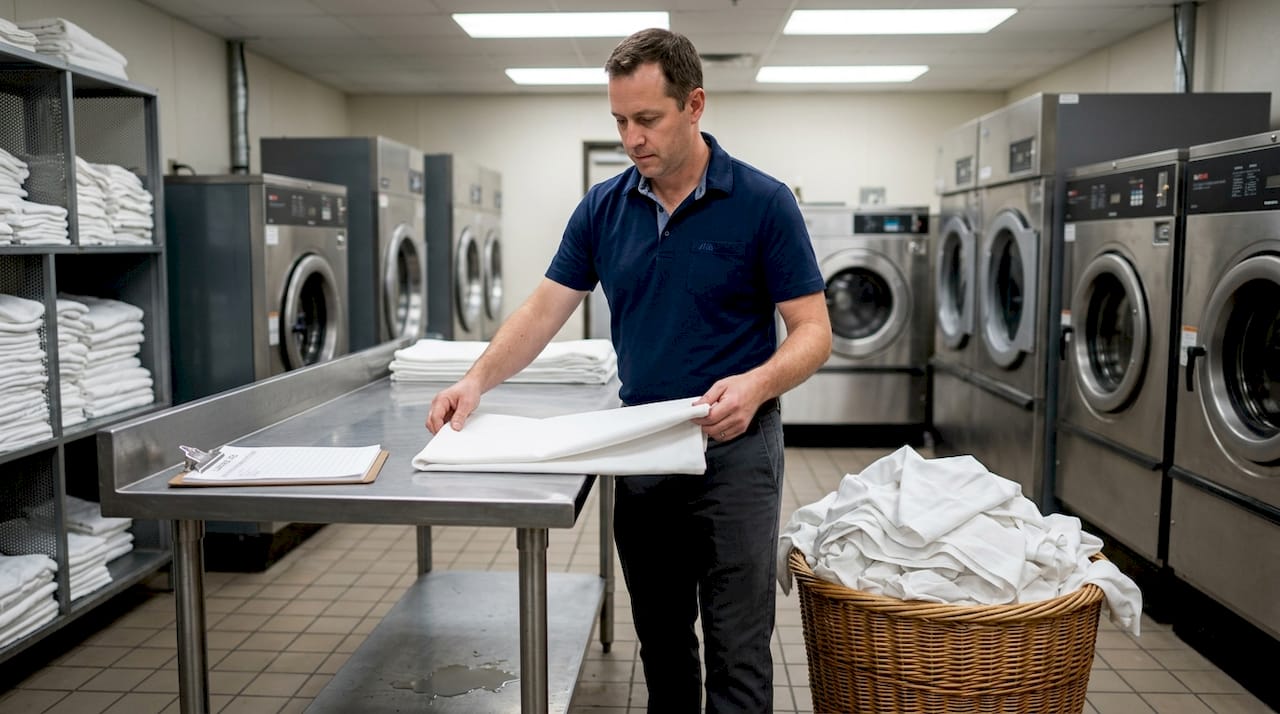
Pro Tip: Always add a 20% emergency buffer on top of your calculated par. Stains during service, last-minute guest count increases, and the occasional item that simply disappears are constants in event operations — not exceptions.
Your event textile solutions checklist: Item-by-item breakdown
With requirements assessed, you can now move through a structured checklist. Below is a numbered rundown of the core event textile items, followed by a reference table for par levels.
- Tablecloths: Cover every table surface with one set in active use plus one full set in reserve. Fabric choice should reflect the event formality; cotton-polyester blends handle industrial washing well and resist rrudhosje (wrinkling) better than pure cotton.
- Napkins: Plan for at least three napkins per seated guest per event session. Napkins have the highest consumption rate of any table textile.
- Chair covers: One cover per chair plus 10% spares for tears and last-minute additions. Chair covers take hard use during long banquets.
- Table runners and overlays: Two sets per table if the event spans multiple services. Runners elevate presentation significantly and are low-cost relative to their visual impact.
- Decorative drapes and backdrops: One primary set plus one backup for any branded or themed installation. These are high-visibility items where failure is immediately noticed.
- Staff uniforms and aprons: At minimum two sets per staff member on duty. Stains mid-event are unavoidable; having a clean change on hand is non-negotiable.
- Spa or pool towels (resort events): Three sets per expected guest if pool access is included. Pool textiles degrade faster than any other category.
Standard par levels for events are 2 to 3 sets per item; add 10 to 15% for shrinkage and theft. Use this table as a quick reference during your procurement planning:
| Textile item | Standard par | Add-on buffer | Special considerations |
|---|---|---|---|
| Tablecloths | 2.5 sets | +15% | Match fabric weight to event formality |
| Napkins | 3 sets | +15% | Highest consumption; prioritize fast drying |
| Chair covers | 1 set + spares | +10% | Check sizing against chair model |
| Table runners | 2 sets | +10% | Color coordination with brand palette |
| Decorative drapes | 1 primary + backup | +10% | Fire-retardant finish for indoor venues |
| Staff uniforms | 2 sets per staff | +10% | Custom branding adds perceived value |
| Pool/spa towels | 3 sets | +15% | Higher shrinkage and fading rate |
Explore the full range of hotel textile options to match each checklist item to a specific product line. For branded events, custom event textile advantages go beyond aesthetics. Also review a standard hygiene checklist to ensure your textile handling practices align with current standards.
Pro Tip: Build this table into a shared spreadsheet with your operations team. Update it after every major event with actual consumption figures. Within two to three event cycles, your par level estimates will sharpen considerably.
Sourcing strategy: Buy vs. rent and supplier selection
With your checklist in hand, the next decision is how to acquire the stock. This is where procurement officers face a genuine strategic choice, and the right answer depends on your event volume, capital position, and branding requirements.
Renting avoids logistics but may limit branding; buying allows customization but requires more capital. The practical reality for most Albanian hotel and restaurant operations is that a mixed model works best: own your core stock for regular events, rent specialty or high-volume items for seasonal peaks.
“The real cost of renting is not the per-piece rate. It is the accumulated cost over 36 months compared to the amortized cost of ownership. Run both scenarios before you commit.”
Key questions to ask any supplier before signing an agreement:
- What is the minimum order quantity, and does it align with your par level requirements?
- What lead times apply for standard versus custom orders?
- Do they carry OEKO-TEX or GOTS certifications for the products you are sourcing?
- What service agreements cover defective or damaged items post-delivery?
- Can they scale delivery volume during your peak season without compromising quality?
EU and Italian suppliers offer short supply chains and eco-compliance options that align with Albania’s growing alignment with European hospitality standards. For properties managing cross-border procurement, the step-by-step procurement guide and regional logistics strategies are practical starting points. Properties purchasing in larger volumes will also find that bulk import savings significantly lower the total cost per item compared to incremental buying. For more detail on managing laundry costs alongside procurement, the guide on cost-saving with hotel laundry covers operational levers worth reviewing.
Sustainability, compliance, and future-proofing textile choices
Procurement decisions made today will shape your operational profile for the next three to five years. Sustainability is no longer a marketing footnote; it is becoming a baseline expectation from guests, event organizers, and increasingly from regulatory bodies across the EU and the Western Balkans.
OEKO-TEX and GOTS compliance reduces water and energy consumption and aligns your operation with ESG targets. For hotels hosting corporate events, this matters. Corporate clients are actively vetting venue suppliers for sustainability credentials, and a certified textile supply chain is a verifiable differentiator.
Certifications and standards to prioritize in supplier evaluation:
- OEKO-TEX Standard 100: Confirms that every component of the textile has been tested for harmful substances.
- GOTS (Global Organic Textile Standard): Covers organic fiber processing, from farm to finished product.
- EU Ecolabel for textile services: Relevant for laundry and rental service providers.
- ISO 14001: Environmental management systems certification for suppliers with larger operations.
“Choosing certified textiles is not just an environmental statement. It is a risk management decision. Regulatory alignment now protects you from retrofit costs and supply chain disruptions later.”
Future-proofing your textile procurement means building flexibility into supplier agreements. Include clauses that allow volume adjustments without penalty for seasonal variation. Request supplier roadmaps showing their investment in sustainable production. Albania’s own sustainability roadmaps and the UNIDO Albania roadmap signal a policy direction that will eventually affect procurement standards for hospitality operators in the country. Starting early gives you leverage in supplier negotiations and reduces the cost of future compliance.
For properties wanting to assess current stock against sustainability benchmarks, fabric testing for sustainability offers a clear methodology. Understanding the sustainable textile impact on guest experience rounds out the business case.
The real event textile edge: Our lessons and what most overlook
After working with hotels and restaurants across Albania for over three decades, certain patterns repeat themselves. The managers who execute events without textile-related crises are rarely the ones with the largest budgets. They are the ones who treat textile planning as an operational system, not a last-minute task.
The biggest mistake we see is underestimating event-specific stock. Managers often pull from guestroom inventory to cover event shortfalls. This creates a cascade: guestrooms come up short, housekeeping improvises, and the standard drops across two departments simultaneously.
Here is the counterintuitive truth: fast, reliable logistics from your supplier rival low unit prices as a driver of event success. A tablecloth that arrives two days late costs more in operational disruption than a tablecloth that costs 15% more but ships overnight. Price matters, but speed and reliability are what keep the service running smoothly.
Most managers also underestimate the indirect return on investment from top-tier event textiles. Guests remember the feel of a well-pressed linen napkin and the crispness of a branded tablecloth long after the food is forgotten. That tactile memory drives repeat bookings and five-star reviews. Explore insider textile tips to see how these details translate into measurable guest loyalty metrics.
Integrate your textile checklist into your broader event operations calendar. Treat it as a standing agenda item at pre-event briefings, not an afterthought.
Procure textile solutions with confidence
Your checklist is only as effective as the supplier behind it. Gjergji H Tekstil has been the supply chain backbone for hospitality operations in Albania since 1994, supplying brands like Marriott, Meliá, and Sheraton with hotel-grade textiles at competitive volume pricing.
Whether you are restocking for a single gala or building out a full-season event inventory, the product range at textile wholesale for hotels covers every checklist item with consistent quality standards. For dining and restaurant operators, textiles for restaurants offers purpose-built solutions for high-use environments. For full event decoration setups, event decor textiles delivers volume, visual impact, and reliable delivery. Contact us to discuss custom orders, bulk pricing, or seasonal procurement agreements.
Frequently asked questions
What is the recommended par level for event textiles in hotels?
Standard par levels for events are 2 to 3 sets per item, with an additional 10 to 15% added for shrinkage and contingencies. Higher-volume or back-to-back events warrant pushing toward the upper end of that range.
Should we buy or rent event textiles for hospitality venues?
Buying gives you full control over branding, quality, and long-term cost per use, while renting reduces upfront capital and logistics. Renting limits customization but works well for specialty items used only a few times per year.
Which certifications should we look for in sustainable textiles?
OEKO-TEX Standard 100 and GOTS are the primary eco-compliance labels recognized across EU and Balkan hospitality markets. Certified textile sourcing supports both guest trust and regulatory alignment.
How can we future-proof textile procurement for events in Albania?
Work with EU and Italian suppliers who offer short supply chains and certified production, and build flexibility clauses into supplier contracts to adapt to seasonal demand shifts and evolving sustainability standards.
Recommended
- Expert tips for selecting textiles to elevate hotel and dining spaces
- Optimize textile maintenance workflow for Albanian hotels
- Textile visual impact: elevate hospitality spaces in 2026
- Textile fabric testing: ensuring quality for hotels & restaurants
- Wedding Planning Made Easy: The Only Checklist You’ll Ever Need – Adelaide Wedding Venues