

TL;DR:
- Importing purpose-built hospitality textiles ensures consistency and meets high-performance standards.
- A well-managed import process reduces costs and enhances guest satisfaction through quality textiles.
- Building strong supplier relationships and verifying certifications are key to successful textile procurement.
Many hospitality operators assume that sourcing textiles locally or picking the cheapest available option is sufficient for day-to-day operations. That assumption is costly. Specialized hospitality textile import directly influences guest satisfaction, operational efficiency, and long-term procurement budgets in ways that generic retail purchasing simply cannot match. Whether you manage a 50-room hotel in Albania, a resort complex along the Adriatic coast, or a multi-venue restaurant group, understanding how textile imports work and what they require will change how you approach procurement. This article breaks down the core concepts, practical steps, quality standards, and cost realities so you can make smarter, more informed sourcing decisions.
Table of Contents
- Understanding hospitality textile import: Definitions and basics
- Key processes: From sourcing to delivery in the Balkans
- Quality, certifications, and compliance: What to demand from suppliers
- Cost factors and the business case for importing textiles
- What most procurement guides miss about hospitality textile imports
- How Gjergji H Tekstil can streamline your hospitality textile import
- Frequently asked questions
Key Takeaways
| Point | Details |
|---|---|
| Definition matters | Hospitality textile import is specialized sourcing for hotels, not retail supply chains. |
| Process clarity prevents delays | Knowing step-by-step procedures and Balkan-specific issues avoids costly surprises. |
| Insist on quality certifications | Request OEKO-TEX or similar standards to eliminate compliance risks. |
| Importing cuts costs | Bulk importing generally secures better quality at a lower long-term price than local buying. |
Understanding hospitality textile import: Definitions and basics
Let’s start with a clear definition. Hospitality textile import refers to the international sourcing and procurement of specialized fabrics and finished textile goods for hotels, restaurants, and resorts. This is not the same as buying fabric rolls from a local wholesaler or ordering household linens from a general retailer. The products involved are purpose-built for commercial environments, and the sourcing process reflects that.
Hospitality textiles cover a wide range of product categories. The most common include:
- Bed linens and sheeting (fitted sheets, flat sheets, pillowcases)
- Terry products (bath towels, hand towels, pool towels)
- Food and beverage textiles (tablecloths, napkins, runners)
- Window treatments (drapery, blackout curtains, sheers)
- Staff uniforms and workwear
Each category has different performance requirements. A hotel bath towel, for example, must withstand hundreds of industrial wash cycles without significant fiber degradation or color loss. A restaurant tablecloth must resist staining and maintain a crisp, presentable appearance through heavy daily use. These are not standards that general retail textiles meet consistently.
The distinction between local sourcing and importing becomes clear when you compare your options side by side:
| Factor | Local sourcing | Imported hospitality textiles |
|---|---|---|
| Product range | Limited, often general-purpose | Wide, purpose-built for hospitality |
| Consistency | Variable by batch | Standardized across large orders |
| Price per unit | Higher for commercial specs | Lower at volume |
| Certifications | Rarely available | Common (OEKO-TEX, ISO) |
| Customization | Minimal | Broad (color, weight, branding) |
Importing opens access to manufacturers in Italy, India, Pakistan, China, and Turkey who produce at scale specifically for the hospitality sector. That production scale is what allows consistent thread count, fabric weight, and finish across every item in an order. Consistency is not a luxury in hospitality operations. It is a baseline standard that your guests notice, even if they cannot articulate why.
Key processes: From sourcing to delivery in the Balkans
With a clear definition in mind, it is crucial to understand how hospitality textile imports actually work from first contact to final delivery. The process has several distinct stages, and each one carries its own risks if not managed carefully.
- Supplier identification and evaluation — Research manufacturers or established distributors with a verified track record in hospitality supply. Review product samples, production capacity, and references from comparable clients.
- Sample ordering and quality testing — Before committing to a large order, request physical samples. Test them under real conditions: wash cycles, ironing, and daily use simulation.
- Order placement and production scheduling — Confirm specifications in writing, including fabric weight (grams per square meter), thread count, dimensions, and color standards. Lock in lead times.
- Shipping and freight coordination — Choose between sea freight (cost-efficient for large volumes) and air freight (faster but significantly more expensive). Most Balkan importers use sea freight through ports like Durrës or Thessaloniki.
- Customs clearance — This is where many first-time importers lose time and money. In the Balkans, customs documentation must be precise. HS codes, certificates of origin, and import declarations must align exactly. Errors cause delays and fines.
- Local delivery and warehouse receipt — Once cleared, goods move to your warehouse or distribution point. Inspect every delivery against the original order before signing receipt.
The textile procurement process in the Balkans has specific considerations that differ from Western European markets. Currency fluctuations, variable customs processing times, and limited local logistics infrastructure mean that timelines can stretch. A shipment from Asia that takes 28 days at sea may spend an additional 10 to 14 days in customs if documentation is incomplete. Streamlined distribution workflows can significantly reduce these delays when you work with experienced partners.

Pro Tip: Build a minimum 3-week buffer into your procurement calendar beyond the supplier’s quoted lead time. This accounts for customs delays, quality re-inspections, and seasonal shipping congestion without leaving your property short-stocked.
Understanding hospitality textile production steps also helps you set realistic expectations with suppliers and negotiate better lead time commitments upfront.
Quality, certifications, and compliance: What to demand from suppliers
Once you are clear on the process, the next priority is quality and compliance. This is where many procurement decisions go wrong, often because buyers focus only on price per unit and overlook the standards that protect both guests and operational budgets.
The most recognized certification in hospitality textiles is OEKO-TEX Standard 100. It certifies that every component of a textile, including threads, dyes, and finishes, has been tested for harmful substances. For a hotel serving guests of all ages and health backgrounds, this is a non-negotiable baseline. Certifications such as OEKO-TEX play a vital role in quality control for hospitality textiles, and their absence from a supplier’s product range should raise an immediate flag.
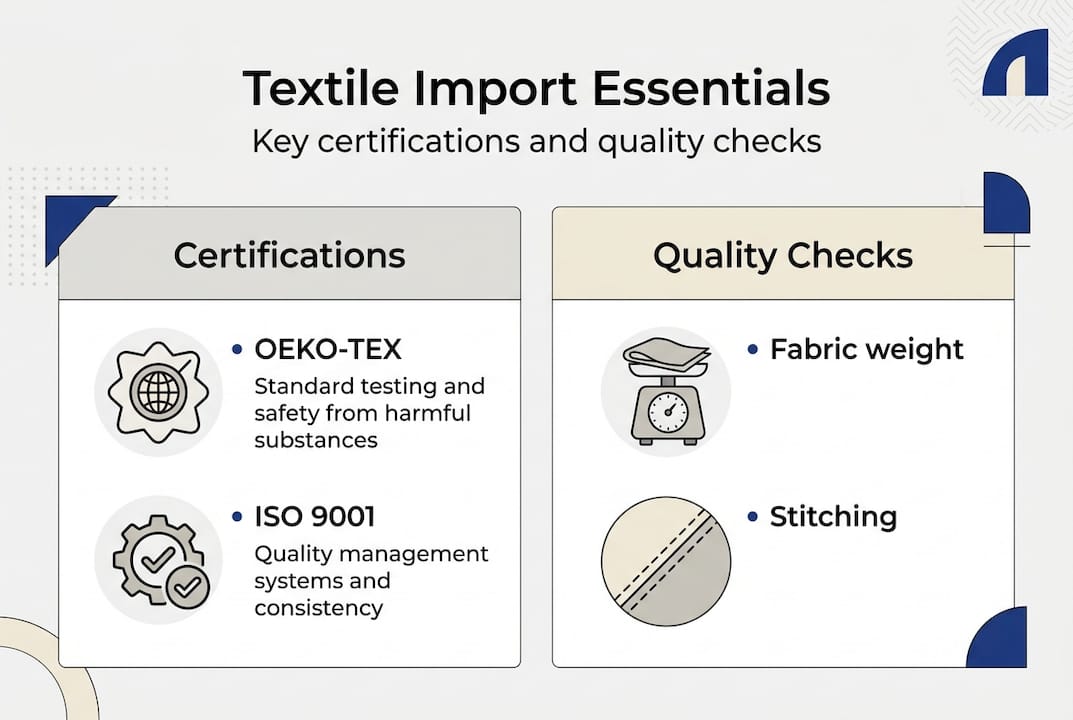
| Certification | What it guarantees |
|---|---|
| OEKO-TEX Standard 100 | No harmful chemicals in the textile |
| ISO 9001 | Consistent quality management processes |
| ISO 14001 | Environmentally responsible production |
| GOTS (Global Organic Textile Standard) | Organic fiber content and processing |
| REACH Compliance | EU chemical safety regulation conformity |
Beyond certifications, you should physically inspect deliveries for key quality indicators. Check fabric weight consistency (measured in grams per square meter, or GSM), seam strength, color fastness after washing, and resistance to pilling. A 500 GSM bath towel that loses half its fiber mass after 50 wash cycles is not a cost-saving purchase. It is a replacement cost waiting to happen.
Compliance with local health and safety regulations in Balkan countries also matters. Some markets require specific documentation for textiles used in direct guest contact, particularly bed linens and towels. Failing to meet these requirements can create liability issues during health inspections.
Pro Tip: Ask every supplier for independent, third-party laboratory test results with each shipment, not just the first order. Consistent documentation proves that quality is maintained across production batches, not just samples.
You can learn more about fabric testing for hotels to build a practical checklist for your receiving team.
Cost factors and the business case for importing textiles
Having established the standards and checkpoints for quality, it is time to address the fundamental question: does importing actually pay off for your operation?
The short answer is yes, when done with a clear cost structure in mind. Importing hospitality textiles can offer significant savings and quality improvements compared to local sourcing, particularly when you purchase at the volumes that mid to large properties require. Here is what makes up the full landed cost of an imported textile order:
- Unit price (FOB or CIF, depending on your arrangement with the supplier)
- Freight costs (sea, air, or road depending on origin and urgency)
- Customs duties and import tariffs (vary by product category and country of origin)
- VAT on importation (applicable in most Balkan markets)
- Minimum order quantities (MOQs that determine whether the unit economics work)
- Internal handling and storage costs after delivery
The hidden costs that catch buyers off-guard include currency exchange losses on non-EUR invoices, re-inspection fees when shipments are held at customs, and replacement orders needed when quality is inconsistent. These are real risks, but they are manageable with the right supplier relationships and documented quality standards.
The financial case for importing becomes stronger as your order volume increases. A hotel purchasing 500 towels locally might pay 4 EUR per unit for a commercial-grade product. The same quality item imported in a 2,000-unit order might cost 2.20 EUR per unit. Over a procurement cycle of three years, accounting for durability differences and replacement frequency, the savings compound significantly.
| Cost element | Local purchase (per unit) | Imported in bulk (per unit) |
|---|---|---|
| Unit price | 4.00 EUR | 2.20 EUR |
| Freight and customs | 0 EUR | 0.35 EUR |
| Total landed cost | 4.00 EUR | 2.55 EUR |
| Estimated lifespan | 150 wash cycles | 300 wash cycles |
| Effective cost per cycle | 0.027 EUR | 0.008 EUR |
The durability factor is the most underestimated element in the cost equation. You can reduce textile expenses significantly not just by buying cheaper, but by buying longer-lasting. Explore the full analysis of bulk import advantages to model this for your own property size.
What most procurement guides miss about hospitality textile imports
Most guides on hospitality textile procurement focus on supplier lists, price comparisons, and shipping timelines. These are useful. But they consistently miss the most important variable: the quality of the ongoing relationship with your supplier.
Price and brochures are a starting point, not a guarantee. A supplier with attractive pricing who cannot communicate clearly, adjust to specification changes, or respond quickly to quality issues is a liability, not an asset. We have seen operators lock into contracts based purely on unit cost, only to face delayed reorders, inconsistent batch quality, and zero flexibility during peak season crunches.
The myth that all imports mean lower quality persists in some Balkan markets. It is simply inaccurate. Major international hotel brands operating in this region source exclusively from international manufacturers because local production capacity cannot meet volume, consistency, or certification requirements at scale. What determines quality is not geography but supplier standards and your ability to enforce them contractually.
Long-term supplier relationships create tangible operational advantages. You get priority in production scheduling, early visibility into price changes, and the ability to customize products without excessive lead time penalties. Read through this expert textile selection advice for a practical framework on building those relationships from the first inquiry forward. The difference between a reactive buyer and a strategic procurement partner often comes down to communication frequency and contractual clarity.
How Gjergji H Tekstil can streamline your hospitality textile import
Ready to put these insights into action? Here is how you can simplify your next hospitality textile import and upgrade guest experiences.

Gjergji H Tekstil has operated as a fully integrated textile supply chain partner for the hospitality sector since 1994, supplying wholesale hotel textiles and restaurant textile solutions to properties across Albania and the wider Balkan region. With direct import relationships across Italy, India, Pakistan, and China, the company controls quality from production to delivery. Whether you need certified bed linens in volume, custom-branded uniforms, or event-ready table dressing, the team offers tailored procurement guidance backed by decades of real operational experience. Explore the documented bulk import savings available for your property size and contact Gjergji H Tekstil for a direct consultation on your next order.
Frequently asked questions
What types of textiles are most commonly imported for hospitality?
Sheeting, towels, table linens, uniforms, and window drapery are the most common hospitality textile imports, covering both guest-facing and operational needs across hotels and restaurants.
How can I be sure imported textiles are high quality and compliant?
Look for certifications like OEKO-TEX and demand detailed test results for every shipment. Quality-certified textiles provide documented proof of safety and performance standards rather than relying solely on supplier assurances.
Is importing textiles more cost-effective for Balkan hotels and restaurants?
Bulk importing consistently produces a lower effective cost per use compared to local sourcing, especially when durability and replacement cycles are factored in. The savings from bulk imports are most significant for properties ordering 500 or more units per category.
What is the main risk in hospitality textile import?
The primary risks are inconsistent quality across batches and unreliable supplier communication, both of which can be managed through documented specifications, certified textile standards, and contractual quality benchmarks enforced at every delivery.