


TL;DR:
- Albania relies heavily on importing textiles due to the decline of domestic production.
- Bulk importing offers better quality consistency and cost savings for large hospitality operations.
- Strategic sourcing and proper planning enhance guest experience and operational efficiency.
Many hoteliers and restaurant managers in Albania assume that sourcing textiles locally is the simpler, cheaper path. In practice, the opposite is often true. Albania relies heavily on textile imports from partners like Italy, Turkey, and China, largely because domestic production capacity has shrunk significantly over the past three decades. This guide explains why that import dependency exists, what it means for your operation, and how a well-structured bulk import strategy can deliver better quality, more consistent inventory, and real cost savings across your property.
Table of Contents
- Why Albania’s hospitality sector relies on textile imports
- Bulk import vs. local procurement: The quality and cost equation
- How bulk imports enhance guest experience and operational efficiency
- Essential steps for successful bulk textile importation
- Why bulk textile import is a strategic advantage for Albanian hospitality
- Ready to transform your textile sourcing?
- Frequently asked questions
Key Takeaways
| Point | Details |
|---|---|
| Import dependence is reality | Hotels and restaurants in Albania rely on bulk textile imports due to shrinking local production. |
| Bulk buying cuts costs | Volume deals and streamlined procurement save money and reduce emergency purchase premiums. |
| Quality drives guest satisfaction | Imported textiles meet durability and comfort standards, enhancing guest experiences. |
| Best practices matter | Successful bulk importing depends on sound planning, trusted suppliers, and proper inventory controls. |
Why Albania’s hospitality sector relies on textile imports
Building on Albania’s surprising import reliance, let’s examine what’s behind it and what it means for your hospitality business.
Albania’s textile manufacturing base was once a meaningful part of its industrial economy. That era is largely over. Deindustrialization, youth migration, and currency shifts have steadily eroded domestic production capacity, leaving businesses that need volume and consistency with few local options. For hospitality operators, this is not a minor inconvenience. It is a structural reality that shapes every procurement decision.
The numbers tell a clear story. Industrial output in Albania dropped by 2.10% in Q1 2025, continuing a pattern that has made local textile sourcing increasingly unreliable for high-volume buyers.
“Albania’s textile sector has declined due to youth migration, currency changes, and overall industrial recession, making import dependency the norm for businesses including hospitality.”
What does this mean for a hotel with 50 rooms or a restaurant running 200 covers a night? It means you cannot count on a local supplier to deliver 300 matching towels, 150 sets of bed linens, and replacement stock on a predictable schedule. The domestic market simply does not have that infrastructure in place.
This is why Albania’s main textile import partners are Italy, Turkey, Greece, China, and Germany. Each country brings something specific to the table. Italy and Germany supply premium-grade fabrics with tighter quality controls. Turkey and China offer strong volume capacity at competitive price points. Greece serves as a regional bridge, often providing faster logistics for smaller top-up orders.
| Import partner | Strength | Typical use in hospitality |
|---|---|---|
| Italy | Premium quality, tight standards | Luxury hotel linens, upscale dining |
| Turkey | Volume capacity, competitive pricing | Mid-range hotels, restaurant tablecloths |
| China | Scale, wide product range | Budget properties, high-turnover items |
| Germany | Technical fabrics, durability | Workwear, specialty applications |
| Greece | Regional proximity, faster logistics | Top-up orders, seasonal restocking |
Understanding textiles’ impact on hospitality spaces starts with understanding where those textiles actually come from. For Albanian operators, imports are not a workaround. They are the primary supply channel, and treating them as such changes how you plan, budget, and negotiate.
Bulk import vs. local procurement: The quality and cost equation
Now that the import reliance is clear, compare how importing in bulk actually stacks up against local sourcing on the issues that matter.
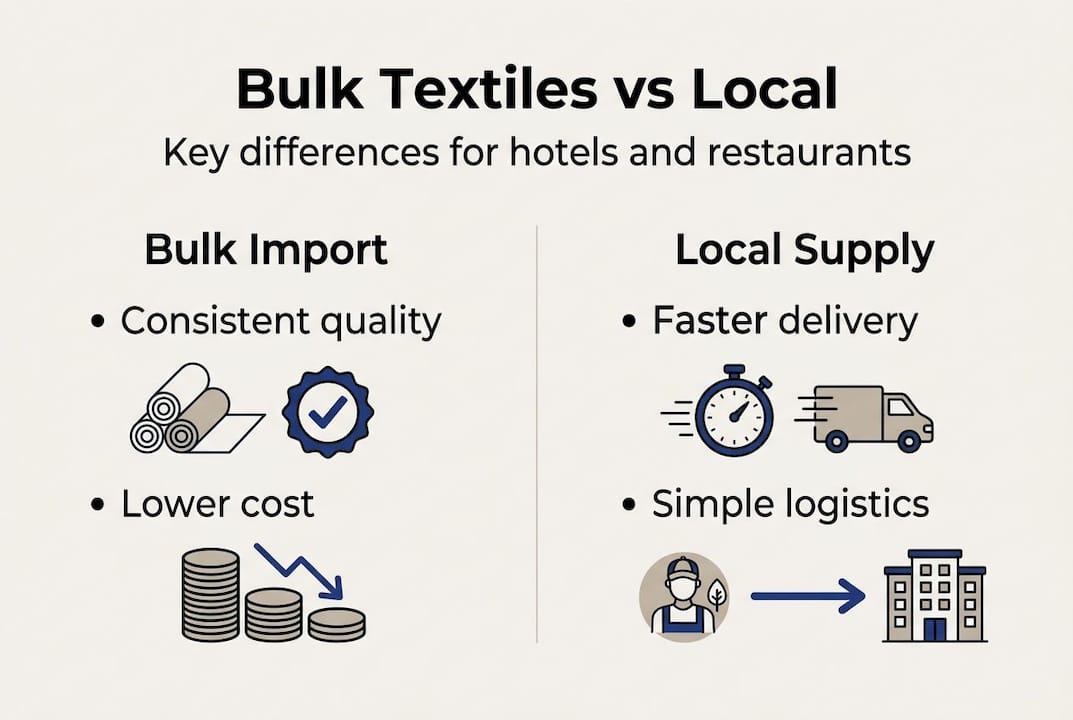
Local procurement has genuine advantages. Shorter lead times, simpler logistics, and less paperwork make it attractive for operators who need something quickly or in small quantities. But for hotels and restaurants running at scale, local sourcing consistently falls short on two critical dimensions: quality consistency and price leverage.
Bulk procurement enables consistency and B2B savings that local buying simply cannot match. When you order 500 towels from a single import batch, every item comes from the same production run, the same fiber blend, and the same dyeing process. That uniformity matters enormously when guests compare rooms or when your front-of-house team sets tables.
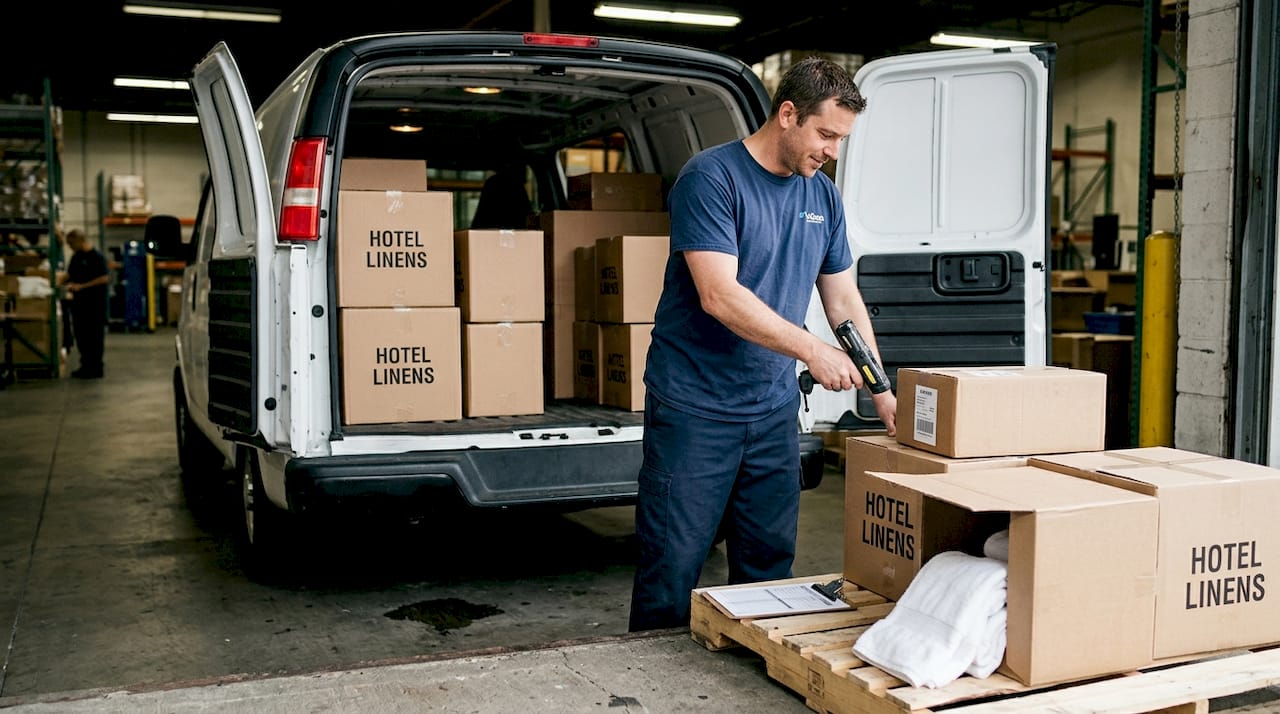
Locally sourced textiles offer supply simplicity but lag in durability and quality for high-traffic hospitality uses. A tablecloth that looks fine in a retail setting may not survive 200 industrial wash cycles. A towel that feels soft on day one may pill and thin out within three months of daily use. These are not hypothetical concerns. They are operational costs that show up in your replacement budget.
| Factor | Bulk import | Local procurement |
|---|---|---|
| Unit cost | Lower at volume | Higher per unit |
| Quality consistency | High (single production run) | Variable |
| Lead time | 3-8 weeks | Days to 1 week |
| Product range | Wide, customizable | Limited |
| Durability (hospitality grade) | High | Often insufficient |
| Logistics complexity | Higher | Lower |
The numbered steps for a cost comparison are straightforward:
- Calculate your annual textile spend at current local prices.
- Request a bulk import quote for the same volume from a verified supplier.
- Add estimated logistics and customs costs to the import figure.
- Compare total cost per unit, not just sticker price.
- Factor in replacement frequency, since lower durability means more frequent buying.
Pro Tip: When negotiating bulk import deals, ask suppliers for a tiered pricing structure. Committing to a 12-month volume agreement often unlocks an additional 8-15% discount compared to single-order pricing. Review your hospitality textile sourcing guide before entering negotiations so you know your baseline numbers.
The benefits of custom imports go beyond price. Custom production runs let you specify thread count, GSM weight, color, and branding details that off-the-shelf local products cannot provide.
How bulk imports enhance guest experience and operational efficiency
Once you see the comparison, you’ll want to know how bulk importing impacts day-to-day hospitality experience for staff and guests.
Guest experience is built on consistency. A guest checking into room 12 expects the same quality of linens as the guest in room 34. When your textile supply is fragmented across multiple local vendors with varying quality standards, that consistency breaks down. Bulk imports solve this at the source.
Par-level inventory management, which means maintaining 3-4 complete sets of linens per room, is the operational standard for hotels that run smoothly. Bulk importing makes par-level management practical because you receive enough stock in a single shipment to establish and maintain those levels without constant reordering.
The operational benefits extend further:
- Predictable cost tracking: A single import invoice covers a large portion of your annual textile needs, making budget forecasting far more accurate.
- Reduced staff time on reordering: Your housekeeping and procurement teams spend less time chasing suppliers and more time on service delivery.
- Stronger brand control: When every towel, sheet, and tablecloth comes from the same production standard, your property’s visual identity stays consistent across all guest touchpoints.
- Lower per-unit replacement cost: Higher-grade imported textiles last longer under industrial washing, which means fewer replacement cycles per year.
The cost of not planning ahead is significant. Emergency textile purchases cost 30-40% more than planned bulk orders. Running out of clean towels during peak season and scrambling for a local emergency buy is not just stressful. It is a direct hit to your operating margin.
Pro Tip: Track your textile replacement rate by category. If you are replacing towels more than twice per year per room, your current product’s GSM is likely too low for your wash cycle volume. Streamlining textile workflows starts with knowing exactly what you are consuming and when.
For restaurants, bulk imports support custom solutions like branded tablecloths and uniform napkin sets that elevate the dining environment without the inconsistency of piecemeal local buying. Managing hospitality inventory risks is always easier when your supply chain is predictable and your stock levels are planned well in advance.
Essential steps for successful bulk textile importation
With advantages understood, here’s exactly how to structure an effective bulk import strategy tailored to hospitality demands.
A bulk import strategy that works is not complicated, but it does require discipline and preparation. Follow these steps to avoid the most common and costly mistakes.
- Forecast your needs accurately. Review the past 12 months of textile consumption by category. Account for seasonal peaks, planned renovations, and any property expansions. Underestimating demand leads to emergency buying. Overestimating ties up capital in excess stock.
- Select suppliers based on verified quality, not just price. Request physical samples before committing to any volume order. Evaluate GSM weight, colorfastness, and stitching quality. Quality benchmarks for hospitality grade textiles are clear: towels should fall between 400-500 GSM, and bed sheets between 200-250 GSM for the durability and comfort your guests expect.
- Negotiate contract terms, not just price. Lock in delivery schedules, quality guarantees, and replacement policies for defective goods. A supplier who cannot commit to a written quality standard is a liability.
- Plan your inventory dynamically. Do not treat bulk imports as a one-time event. Build a rolling 6-month inventory plan that accounts for lead times of 3-8 weeks and seasonal demand shifts.
- Use cost-per-use metrics to evaluate purchases. A towel that costs twice as much but lasts three times longer is the better investment. Review expert textile selection tips to build a cost-per-use framework before your next procurement cycle.
Common pitfalls include overstocking slow-moving items, underestimating customs clearance timelines, and skipping the physical sample evaluation stage. Each of these mistakes is avoidable with proper planning.
Pro Tip: Build a 10-15% buffer into every bulk order to cover unexpected demand spikes, defective units, or delayed follow-up shipments. This buffer costs less than a single emergency purchase at peak season rates.
Why bulk textile import is a strategic advantage for Albanian hospitality
After detailing the practical steps, it is worth pausing to share how true hospitality leaders approach bulk imports, based on real-world lessons.
Most operators we work with initially resist the idea of bulk importing. The objections are familiar: it feels complicated, the upfront cost looks high, and there is a comfort in buying from someone local. That resistance is understandable. It is also expensive.
The operators who shift their thinking from price to brand differentiation are the ones who pull ahead. When your linens are consistently soft, your tablecloths are always crisp, and your staff uniforms look sharp across every shift, guests notice. They may not say “your GSM is excellent.” But they will leave a better review, return more often, and recommend your property.
Investing in quality textiles is not a luxury decision. It is a guest loyalty decision. The Albanian hospitality market is becoming more competitive every year, and the properties that win are the ones that control their standards at the supply chain level, not just at the front desk.
Bulk import, done right, is how you take that control.
Ready to transform your textile sourcing?
If your team is ready to activate the benefits of bulk textile import, here’s how to build your advantage.
Gjergji H Tekstil has been supplying hotels and restaurants across Albania and the region since 1994, working with properties ranging from boutique guesthouses to international brands like Marriott and Sheraton. Whether you need wholesale hotel textiles for a full property restock or restaurant textiles in bulk for a dining room refresh, the team can structure a sourcing plan that fits your volume, budget, and quality standards.

Explore the full procurement guide to understand exactly what to ask for, what to measure, and how to negotiate your next bulk import with confidence. The right textile partner does not just sell you product. They help you run a better operation.
Frequently asked questions
Why not just buy textiles from local suppliers in Albania?
Due to declining domestic production, local suppliers often cannot meet the quality, consistency, or quantity requirements that hotels and restaurants need to operate at standard. Import dependency is now the structural norm, not the exception.
How does bulk importing of textiles reduce costs?
Bulk buying unlocks volume pricing from suppliers and eliminates the need for costly emergency purchases, which can run 30-40% more expensive than planned orders. The savings compound over a full operating year.
What quality benchmarks should I check when importing textiles?
For hospitality use, GSM benchmarks are the starting point: towels should be 400-500 GSM and bed sheets 200-250 GSM to deliver the durability and comfort that guests expect under regular industrial washing.
Which countries supply most of Albania’s bulk textile imports?
Italy, Turkey, Greece, China, and Germany are the top textile suppliers for Albania’s hospitality market, each offering different strengths in quality, volume, and pricing.
Recommended
- Textile procurement in hospitality: A manager’s guide
- Streamline textile distribution workflows in Balkans hospitality
- Why invest in custom textiles for hotels: boost guest experience
- Textile visual impact: elevate hospitality spaces in 2026
- Bulk printing advantages: save costs and boost efficiency – Transfer Kingz