

TL;DR:
- Regional Balkan supply chains offer faster response, reliable quality, and EU certification for hotel textiles.
- Precise specifications and early logistics planning prevent order errors and shipment delays.
- Ongoing quality verification and supplier communication are key to smooth textile procurement.
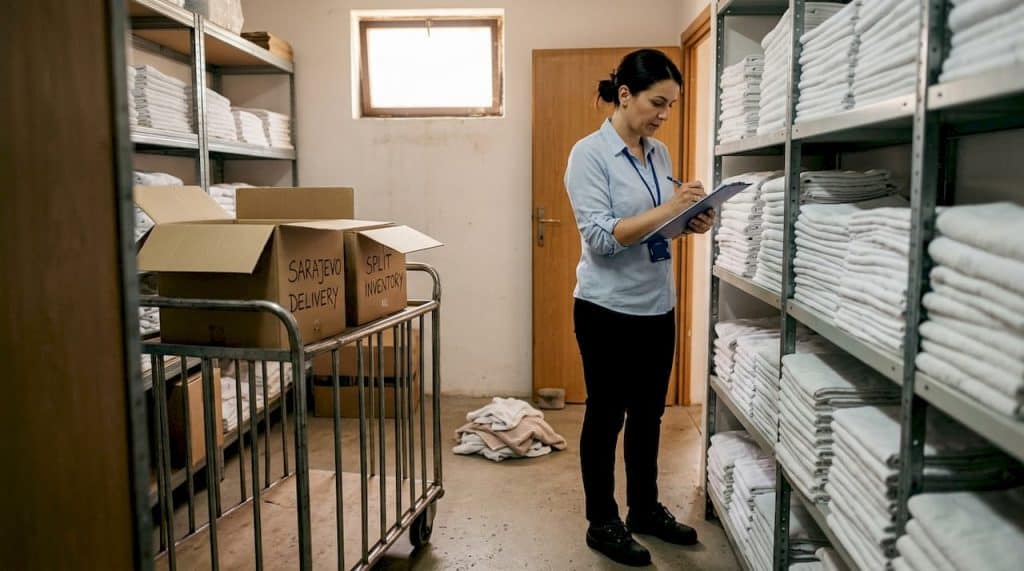
Textile supply chain failures are among the most underestimated operational risks in Balkans hospitality. A delayed shipment of bed linens before peak season, a branding mismatch on staff uniforms, or a batch of towels that shrinks after three wash cycles, these are not minor inconveniences. They translate directly into guest complaints, staff inefficiency, and unplanned procurement costs. This guide walks hospitality managers and procurement professionals through a structured workflow: from assessing your textile needs and selecting regional partners, to executing orders efficiently and verifying results on arrival. The goal is a procurement process that keeps your operation running without interruption.
Table of Contents
- Assessing your textile requirements and supply chain options
- Preparing for streamlined procurement and customization
- Execution: Optimizing logistics for fast, reliable delivery
- Verifying results and troubleshooting common pitfalls
- Why Balkan supply chains outpace overseas alternatives
- Partner with trusted hospitality textile experts
- Frequently asked questions
Key Takeaways
| Point | Details |
|---|---|
| Local sourcing advantage | Regional textile partners reduce delivery times, ensure compliance, and provide custom options. |
| Clear specifications matter | Precise procurement specs are crucial to avoid costly mistakes and delays. |
| Verification prevents issues | Thorough inspection at delivery prevents small errors from impacting guest satisfaction. |
| Certified textiles preferred | OEKO-TEX certified textiles offer safety, durability, and peace of mind for hospitality managers. |
Assessing your textile requirements and supply chain options
With the benefits of efficient distribution in mind, start by realistically assessing your current textile demands and the capabilities of your supply network. Before you contact a single vendor, you need a clear picture of what your property actually consumes.
Hotel textile categories typically break down into four operational groups:
- Room textiles: Bed sheets, pillowcases, duvet covers, mattress protectors
- Bath textiles: Towels, bathrobes, bath mats
- Food and beverage textiles: Tablecloths, napkins, runners, bar cloths
- Staff workwear: Uniforms, aprons, housekeeping attire
Each category has distinct performance requirements. Room textiles need high thread counts and resistance to industrial washing cycles. Bath textiles require absorbency retention after repeated laundering. Workwear demands durability and, increasingly, branded customization that reflects your property’s identity.
Certification matters more than most managers initially realize. OEKO-TEX certification, for example, confirms that textiles are free from harmful substances and produced under consistent manufacturing standards. For hotels serving international guests, this is not optional branding, it is a credibility signal. When evaluating suppliers, verify certification documentation rather than accepting verbal assurances.
For regional sourcing, the Balkans supply landscape has improved significantly. Partners like Diogen in Bulgaria operate with EU-compliant stock, OEKO-TEX certification, and robust logistics networks tailored to regional hotel needs. This matters because a supplier with EU-based inventory can fulfill urgent orders without the customs friction that overseas shipments routinely create. Review your hotel textile sourcing options with regional logistics as a primary filter, not an afterthought.
| Textile category | Key performance requirement | Certification to request |
|---|---|---|
| Bed linens | Thread count, shrink resistance | OEKO-TEX Standard 100 |
| Towels | Absorbency retention | OEKO-TEX Standard 100 |
| Uniforms | Colorfastness, durability | ISO 105 or equivalent |
| Table linens | Stain resistance, appearance | OEKO-TEX or equivalent |
Once you have mapped your categories and performance benchmarks, review your custom textile solutions list to match your needs against available regional options.
Pro Tip: Always specify logistics terms in your purchase agreements. CIF (Cost, Insurance, and Freight) and DDP (Delivered Duty Paid) terms shift customs responsibility to the supplier, protecting you from unexpected import costs and clearance delays at Balkans border crossings.
Preparing for streamlined procurement and customization
After mapping out your needs and choosing fitting partners, preparation ensures your procurement process is airtight and customization requests go smoothly. Vague specifications are the single biggest cause of order errors in hotel textile procurement.
Before issuing any purchase order, document the following for each textile category:
- Fabric composition (e.g., 100% cotton, 50/50 cotton-polyester blend)
- Thread count or GSM weight (grams per square meter for towels and heavy linens)
- Exact dimensions in centimeters for each item type
- Color specifications using standardized codes (Pantone or RAL for branded items)
- Branding requirements: embroidery placement, label printing, logo dimensions
- Minimum order quantities and acceptable tolerance ranges
Once specifications are documented, evaluate your vendor’s ability to execute. Can they produce samples within five to seven business days? Do they offer in-house label printing and embroidery, or do they outsource it? Outsourced customization adds lead time and introduces quality variation. Regional durable hotel fabrics suppliers who handle customization in-house are consistently more reliable for branded hotel programs.
The choice between a direct manufacturer and an intermediate distributor also affects your flexibility:
| Factor | Direct manufacturer | Regional distributor |
|---|---|---|
| Minimum order | High (500+ units typical) | Lower, more flexible |
| Customization speed | Slower (production queue) | Faster (stock + finishing) |
| Price per unit | Lower at scale | Slightly higher |
| Lead time | 4 to 8 weeks | 1 to 3 weeks |
| Communication | Requires export experience | Local language, faster response |
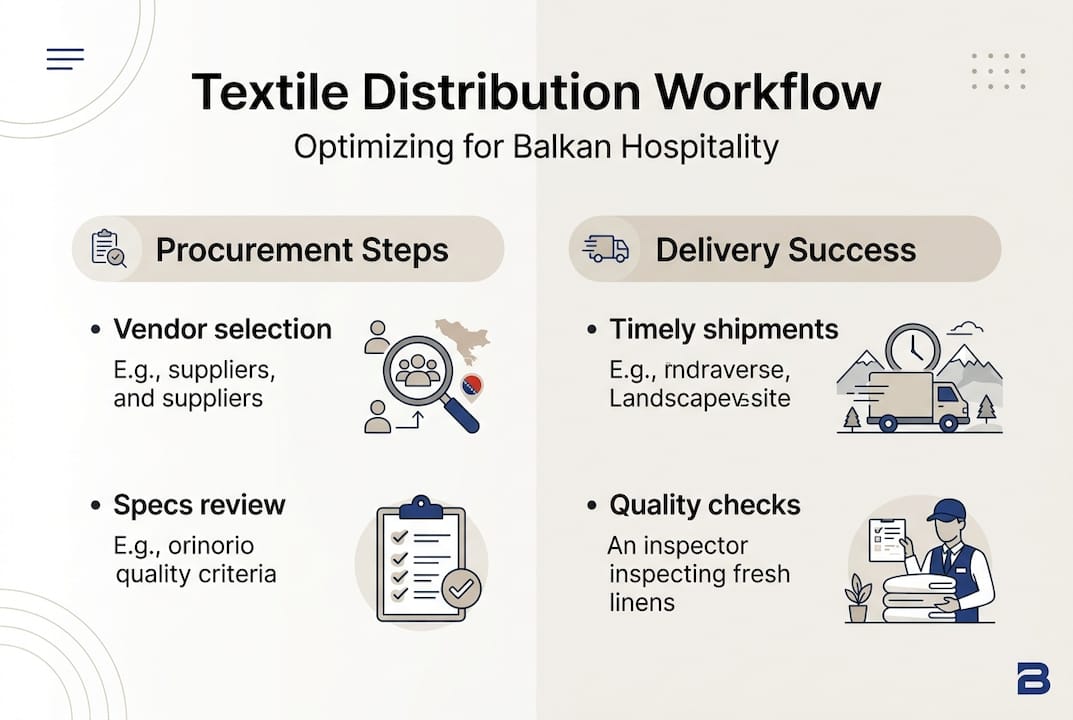
For most Balkans hotels managing seasonal demand spikes, a regional distributor like Diogen, Modak, or Toni-Tex offers the best balance of speed, customization capability, and EU-compliant supply. These firms operate with short-chain logistics ideal for the region. Use the textile procurement guide to structure your vendor evaluation process.
Pro Tip: Request that your supplier hold EU-based inventory for your account during peak months. This eliminates currency fluctuation risk on reorders and cuts lead times to under two weeks for most standard items.
Execution: Optimizing logistics for fast, reliable delivery
With clear specs and vendors lined up, the next step is executing purchases efficiently and reliably. A well-prepared procurement plan fails quickly if the logistics execution is disorganized.

Start by establishing firm delivery timelines tied to your property’s operational calendar. Peak season preparation in the Balkans typically means finalizing textile orders no later than eight to ten weeks before opening. Factor in production time, shipping, and a buffer for customs clearance or quality re-inspection.
Digital order tracking is no longer optional. Most credible regional suppliers now offer order status updates via email or supplier portals. If your current vendor cannot provide shipment tracking documentation, that is a process gap worth addressing. Use a simple shared spreadsheet or procurement software to log:
- Order date and purchase order number
- Expected delivery date
- Item quantities and specifications confirmed
- Supplier contact and escalation contact
- Actual delivery date and variance notes
Bulk ordering with scheduled delivery windows significantly reduces your per-unit cost and logistics overhead. Rather than placing frequent small orders, consolidate quarterly or semi-annual orders for stable items like towels and bed linens. Bulk towel orders placed in advance allow suppliers to prioritize your account during high-demand periods.
On arrival, every shipment requires a quality inspection before items enter your linen room. Customization and spec compliance must be verified against your original purchase order. A basic inspection covers weight verification per item, colorfastness check on a sample batch, dimensional accuracy, branding placement accuracy, and packaging integrity.
Pro Tip: Communicate your peak season dates to your textile supplier at least three months in advance. Suppliers prioritize clients who give them planning visibility, and that translates directly into better logistics scheduling and faster fulfillment when demand is highest.
For ongoing textile maintenance optimization, align your delivery schedule with your laundry cycle capacity so incoming stock does not create storage bottlenecks.
Verifying results and troubleshooting common pitfalls
Once textiles are delivered, successful outcomes rely on thorough verification. Avoid complacency here, minor issues caught on arrival prevent larger operational problems downstream.
A structured incoming batch checklist should cover:
- Quantity verification: Count all items against the packing list before signing receipt
- Specification review: Cross-check fabric composition, dimensions, and thread count against the purchase order
- Branding accuracy: Confirm embroidery, label placement, and color match to approved samples
- Certification documentation: Collect OEKO-TEX certificates and keep them on file for audits
- Storage readiness: Ensure items are clean, dry, and properly packaged before shelving
The most common errors in hotel textile procurement follow predictable patterns. Size mismatches are frequent when specifications are communicated verbally rather than in writing. Missed branding occurs when customization is subcontracted without your direct approval of the subcontractor’s output. Delivery shortfalls happen when suppliers fulfill partial orders without notifying the buyer in advance.
“Never skip incoming batch checks. Minor flaws can multiply guest complaints within days of a new linen cycle.”
When an issue is identified, act within your contractual notification window, typically 48 to 72 hours after delivery. Document the defect with photographs, reference the specific purchase order line, and submit a formal written notification to your supplier. Track each resolution case to completion. OEKO-TEX certified Balkans operations generally have structured claims processes, but you must initiate them promptly.
For a full verification framework, review the verify textile solution outcomes checklist and consult hotel textile support services for ongoing quality assurance support.
Steps to remedy a confirmed defect:
- Photograph and document the issue with reference to PO line items
- Notify the supplier in writing within the agreed claims window
- Request a replacement shipment or credit note, depending on urgency
- Update your vendor scorecard to reflect the incident
- Review your specification documentation to prevent recurrence
Why Balkan supply chains outpace overseas alternatives
The conventional procurement instinct is to chase the lowest unit price, often pointing toward distant manufacturers in Asia. That logic works on a spreadsheet. It breaks down in practice when a delayed container leaves your housekeeping team short on towels during a full-occupancy weekend.
Regional supply chains in the Balkans offer something overseas alternatives cannot: speed of response when things go wrong. A supplier operating with EU-based inventory can respond to an urgent reorder in days, not weeks. Communication happens in shared time zones. Regulatory compliance, including OEKO-TEX certification and EU import standards, is already built into the product.
Partners like Diogen, Modak, and Toni-Tex have built their businesses around the specific operational rhythms of Balkans hospitality. They understand seasonal demand patterns, regional customs processes, and the branding expectations of international hotel brands. That contextual knowledge has real operational value. Structuring your regional textile procurement strategies around proximity and reliability, rather than unit price alone, is the approach that sustains quality over multiple seasons.
Partner with trusted hospitality textile experts
For hospitality managers ready to overhaul textile operations, local expertise provides a competitive edge. Gjergji H Tekstil has operated as a supply chain partner for hotels, resorts, and hospitality businesses across the region since 1994, supplying international brands including Meliá, Marriott, and Sheraton.

Whether you need wholesale hotel textiles at scale, a structured hospitality textile procurement guide to formalize your process, or access to custom hospitality textile solutions tailored to your property’s brand standards, the team at Gjergji H Tekstil brings over 30 years of operational experience to every client relationship. Reach out to discuss your property’s specific requirements and get a sourcing plan built around your operational calendar.
Frequently asked questions
What textile certifications are most important for hotels in the Balkans?
OEKO-TEX certification ensures textiles are free from harmful substances and meet consistent manufacturing standards for hospitality use. It is the baseline certification to request from any regional supplier.
How do I avoid textile shipment delays or customs issues in the region?
Choose suppliers offering CIF or DDP logistics terms and maintain regional inventory to shift customs responsibility to the supplier and accelerate delivery timelines.
Can I get customized hotel textiles in small batches?
Regional suppliers like Diogen and Modak fulfill custom textile orders in both bulk and small batches, including embroidery, label printing, and branded finishing.
What are the most common purchasing mistakes hotel managers make?
Failing to document specifications in writing, skipping incoming quality checks, and underestimating lead times are the three most frequent and costly errors in hotel textile procurement.