

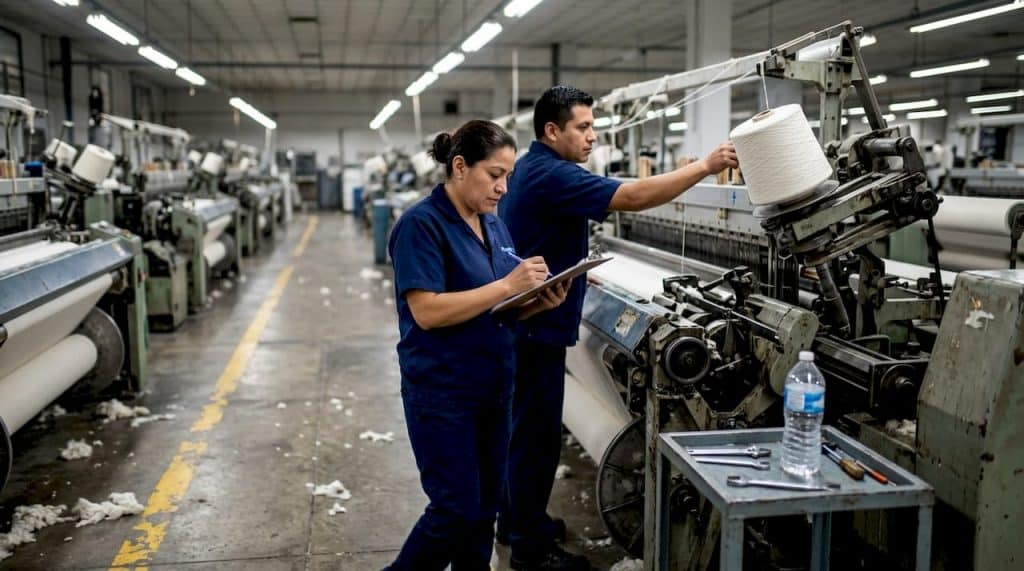
TL;DR:
- The quality of hospitality textiles depends on multiple production stages, not just thread count.
- Fabric formation methods like weaving, knitting, and nonwovens influence durability and cost.
- Understanding and controlling each stage improves long-term value and reduces replacement costs for hotels.
Most hospitality managers assume that thread count and fabric type are the main drivers of guest comfort. That assumption is understandable, but it only tells part of the story. The softness of a hotel towel, the durability of a restaurant napkin, and the colorfastness of a bed sheet are all determined long before the product reaches your property. They are the result of a rigorous, multi-stage manufacturing process that shapes every performance characteristic you care about. This guide walks you through each stage, so you can make sourcing decisions with confidence and stop paying for textiles that underperform under real hospitality conditions.
Table of Contents
- The five essential stages of textile production
- Yarn and fabric formation: Weaving, knitting, and nonwovens
- Wet processing: Enhancing comfort, color, and sustainability
- From fabric to finished product: The final manufacturing steps
- Our perspective: What hospitality managers often overlook in textile sourcing
- How to source quality hospitality textiles in Albania and the Balkans
- Frequently asked questions
Key Takeaways
| Point | Details |
|---|---|
| Five-stage process | Every textile for hospitality use passes through five critical production stages that determine its quality. |
| Fabric selection matters | Understanding weaving, knitting, and finishing helps you match products to guest needs and operational realities. |
| Wet processing impacts cost and sustainability | This stage shapes both durability and a textile’s environmental footprint, so ask suppliers about their processes. |
| Testing and certifications | Always require proof of quality control and durability—these save money and hassle over time. |
The five essential stages of textile production
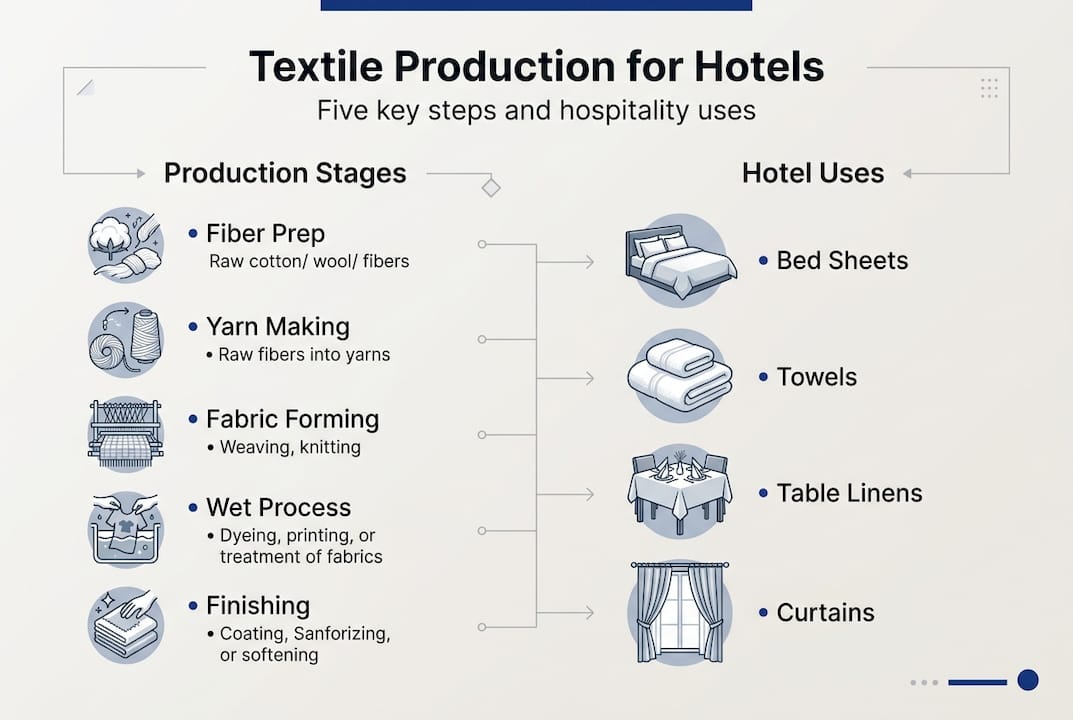
Now that you understand why the process matters, let’s break down each stage in plain language. Textile production consists of five main stages, and understanding each one changes how you evaluate suppliers and specifications.
- Fiber sourcing and preparation. This is where it all starts. Cotton, polyester, linen, and blended fibers are cleaned, combed, and aligned. The quality of raw fiber directly affects how soft and durable the final product feels.
- Yarn production. Prepared fibers are spun into yarn. Yarn twist, thickness, and fiber blending at this stage influence tensile strength and how well the fabric holds up across hundreds of wash cycles.
- Fabric formation. Yarn is transformed into fabric through weaving, knitting, or nonwoven bonding. This stage largely determines the fabric’s structure, weight, and performance profile.
- Wet processing. Fabric is bleached, dyed, printed, and chemically finished. This is where color, softness, and stain resistance are built in, and where the textile gains its hospitality-grade characteristics.
- Product manufacturing. Finished fabric is cut, sewn, quality checked, and packaged as the final product: bed sheets, towels, napkins, or uniforms.
| Production stage | Key output | Common hospitality products |
|---|---|---|
| Fiber preparation | Clean, aligned raw material | Base for all linens |
| Yarn production | Spun yarn of defined strength | Sheet fabric, toweling |
| Fabric formation | Woven, knit, or bonded textile | Sheets, towels, covers |
| Wet processing | Colored, finished fabric | All dyed or treated items |
| Product manufacturing | Ready-to-use textile item | Bed linens, napkins, uniforms |
Choices made at every stage directly affect hotel textile options: a hotel that specifies a higher-twist yarn in stage two will get a more durable sheet. A manager who understands finishing in stage four will ask better questions about shrinkage resistance. Building this knowledge into your textile maintenance workflow reduces replacement frequency and cuts long-term costs.
Pro Tip: When reviewing supplier samples, ask specifically which finishing treatments were applied and at what stage. This tells you far more than a thread count number alone.
Yarn and fabric formation: Weaving, knitting, and nonwovens
Once fiber is spun into yarn, the way it’s built into fabric determines much of the product’s performance. Weaving interlaces warp and weft yarns on looms; knitting forms loops; nonwovens bond fibers without spinning. Each method produces a fundamentally different textile with its own strengths and cost profile.
Woven fabrics are the standard for hotel bed sheets, bath towels, and restaurant tablecloths. The interlocked structure gives them dimensional stability, meaning they hold their shape after repeated industrial washing. Percale and sateen weaves are both popular in hospitality: percale is crisp and cool; sateen is smooth and has a slight sheen. Jacquard weaving, which uses a programmable loom, allows decorative patterns to be built directly into the fabric structure rather than printed on the surface. This is important because woven patterns resist fading far better than surface prints, which matters when your linens go through daily wash cycles.
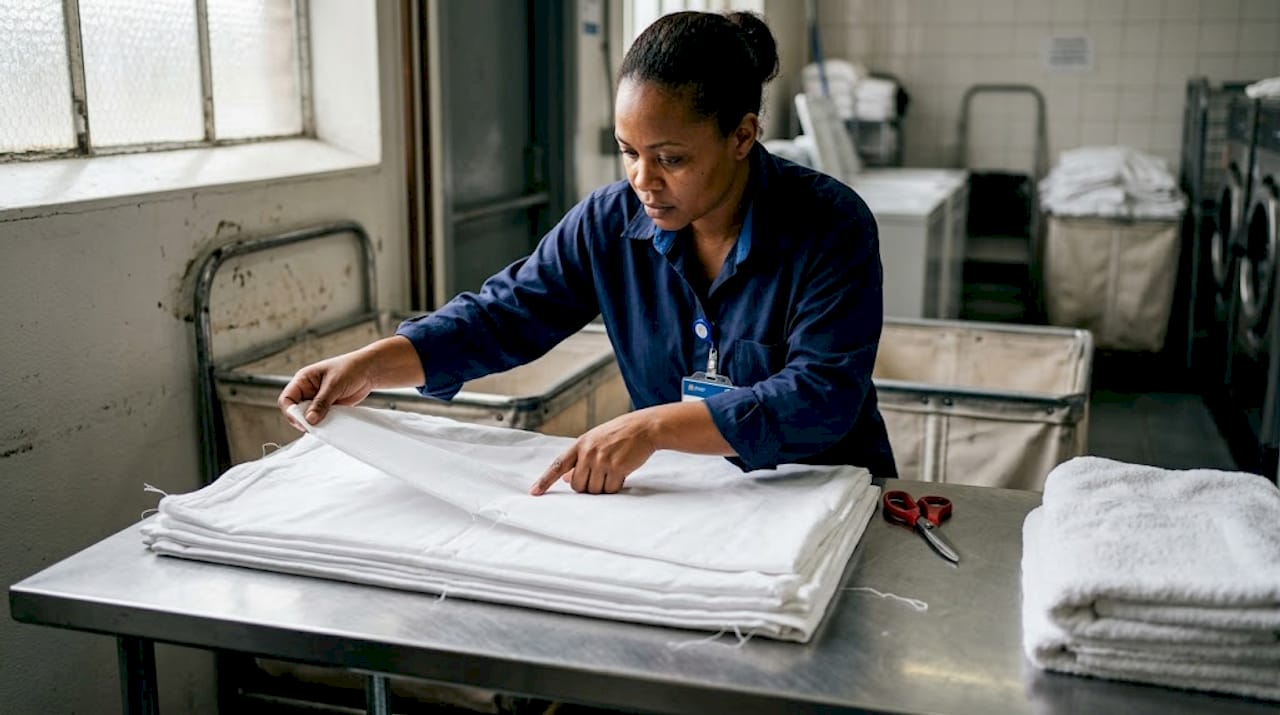
Knitted fabrics form loops rather than interlocked rows. This gives them stretch and flexibility, making them well-suited for fitted mattress covers, spa robes, and some types of stretch upholstery. They are less common for flat linens because they are more prone to snagging and dimensional change after washing.
Nonwoven fabrics skip spinning and yarn formation entirely. Fibers are bonded by heat, pressure, or chemical agents. The result is a low-cost, disposable material used for single-use items: disposable bath mats, pillow protectors, or guest amenity wraps. They are not a replacement for durable woven linens but fill a specific operational role.
| Method | Key properties | Common hotel uses |
|---|---|---|
| Weaving | Durable, stable, pattern-capable | Sheets, towels, tablecloths |
| Knitting | Stretchy, soft, flexible | Mattress covers, robes |
| Nonwovens | Low cost, single-use, lightweight | Disposables, protective layers |
For quality fabric testing, the formation method is one of the first variables to assess. A woven fabric with a tight construction will show measurably better durability traits under abrasion testing than a loosely knitted alternative at the same price point.
Pro Tip: Ask suppliers for their loom efficiency rates. Higher efficiency typically means tighter, more consistent weave structures and better value per square meter over the lifespan of the linen.
Wet processing: Enhancing comfort, color, and sustainability
After fabric formation, the textile undergoes chemical and mechanical treatments to reach hospitality-grade quality. This stage is technically complex, and its environmental footprint is significant. Wet processing accounts for 53% of fashion supply chain GHG emissions and is central to dyeing and finishing outcomes. For hospitality procurement teams, this matters both for sustainability reporting and for understanding why better-finished textiles cost more upfront.
The major wet processing steps are:
- Pretreatment: Fabric is washed, desized, and scoured to remove natural impurities and preparation chemicals. This opens the fiber structure for better dye penetration.
- Bleaching: Removes natural color to create a consistent white base, critical for hotel linens where bright white signals cleanliness to guests.
- Dyeing: Color is applied under controlled temperature and pressure conditions. Reactive dyes bond chemically to cotton fibers, producing better wash-fastness than older methods.
- Printing: Localized color or pattern application, used for decorative towels, branded napkins, and event textiles.
- Finishing: Softeners, wrinkle-resistant treatments, stain repellents, and antimicrobial agents are applied. This is where visual textile impact and tactile comfort are finalized.
One process worth knowing is mercerization, where cotton fabric is treated with a sodium hydroxide solution under tension. Mercerization boosts dye uptake by 25 to 30%, producing richer, more consistent color while also increasing fiber strength. Mercerized cotton linens hold their color longer across high-frequency washing, which reduces replacement cycles.
“The future of textile processing is not just cleaner chemistry, it is smarter chemistry. Hotels that specify eco-finished linens today are building a lower-cost maintenance cycle for tomorrow.”
For your textile procurement guide, ask suppliers whether their fabrics carry certifications such as OEKO-TEX Standard 100, GOTS, or Bluesign. These confirm that harmful substances were excluded from wet processing. You can also review hospitality loyalty strategies to understand how product quality and guest perception connect at the operational level.
From fabric to finished product: The final manufacturing steps
Once a textile is finished for performance, it finally becomes a hospitality product through careful manufacturing. This final phase is where quality control either protects or undermines everything built in the earlier stages.
- Spreading and cutting. Finished fabric rolls are laid flat in multiple layers and cut according to precise patterns. Cutting accuracy directly affects seam quality and finished dimensions.
- Stitching and sewing. Cut pieces are joined using industrial sewing machines. Seam type, stitch density, and thread quality all determine how well the product holds together through repeated washing.
- Quality control and testing. Finished items are inspected for dimensional accuracy, colorfastness, shrinkage, and seam strength. This is where substandard units are removed before shipment.
- Packaging and labeling. Approved products are folded, packaged, and labeled for distribution. Proper packaging prevents contamination during transport.
Woven fabric manufacturing costs approximately $0.94 USD per meter, with yarn spinning at around $1.63 USD per kilogram, and regional differences in carbon footprint vary significantly. Understanding these benchmarks helps you assess whether a supplier’s pricing reflects genuine quality or cost-cutting at the manufacturing stage.
A key variable in final manufacturing is the bulk textile import strategy you adopt. High-volume purchasing from suppliers who control their own manufacturing lets you negotiate tighter quality specifications and get better consistency across large orders. For properties investing in branded or custom products, custom textile investments in this final stage, such as branded embroidery or custom sizing, add measurable value to the guest experience.
Pro Tip: Before finalizing any supplier contract, require documented test results for colorfastness after 50 wash cycles and dimensional change after washing. These two tests alone eliminate most low-quality products from consideration.
Our perspective: What hospitality managers often overlook in textile sourcing
With the main process clear, it’s time to consider what most hospitality decision-makers miss when sourcing textiles. After working with properties across Albania and the Balkans for over 30 years, a consistent pattern emerges: managers focus on purchase price and thread count, and they ignore the process variables that actually determine long-term cost.
A towel bought at a lower price but finished without proper mercerization will lose color vibrancy within 20 wash cycles. A sheet sourced without asking about wet processing certifications may contain residual chemicals that irritate guest skin and trigger complaints. These are not hypothetical scenarios. They are operational realities that translate directly into higher replacement costs and negative reviews.
Three questions every hospitality manager should be asking textile suppliers, but rarely does:
- What finishing treatments were applied, and are they certified to OEKO-TEX or equivalent standards?
- What are the documented colorfastness and shrinkage results after 50 industrial washes?
- Does your production facility control all five stages in-house, or are stages subcontracted?
The third question matters most. Suppliers who control their own supply chain from fiber to finished product deliver more consistent quality because they own every quality decision. Those who subcontract stages introduce variability that you, as the buyer, cannot see or control.
Review expert textile selection tips to build a more structured supplier evaluation process.
Pro Tip: Treat your textile program as a system. From production process through maintenance workflow, every element should be designed to reduce total cost of ownership, not just the invoice price.
How to source quality hospitality textiles in Albania and the Balkans
With a clearer understanding of the textile production process, hospitality managers can now approach sourcing with new confidence.

Knowing how each production stage affects quality puts you in a much stronger position when evaluating suppliers. Working with a partner who controls the full supply chain, from raw fiber sourcing to finished product delivery, eliminates the guesswork and quality gaps that come from fragmented sourcing. Gjergji H Tekstil has supplied wholesale hotel textiles to properties including Meliá, Marriott, and Sheraton, which reflects a consistent quality standard. For managers who want to go deeper, reviewing hospitality textile quality testing standards or exploring how to streamline textile workflows across your operations are practical next steps.
Frequently asked questions
What are the key steps in textile production for hotels?
The production process covers five main stages: fiber preparation, yarn production, fabric formation, wet processing, and final product manufacturing. Each stage shapes the quality, cost, and durability of hospitality linens.
Which fabrics are best for hospitality linens?
Woven cotton performs consistently for hotel sheets and towels due to its durability, softness after washing, and compatibility with industrial laundering. High-quality cotton-polyester blends also offer good longevity at lower cost.
How does wet processing affect textile sustainability?
Wet processing drives over half of textile supply chain GHG emissions. Advanced finishing techniques and certified processes can significantly reduce this impact without sacrificing performance.
What should I ask textile suppliers before purchase?
Ask about processing certifications and test results covering wash durability, shrinkage, and colorfastness. These questions quickly separate suppliers who control quality from those who simply resell untested products.
Recommended
- Textile procurement in hospitality: A manager’s guide
- Optimize textile maintenance workflow for Albanian hotels
- Textile visual impact: elevate hospitality spaces in 2026
- Textile fabric testing: ensuring quality for hotels & restaurants
- Comprendre la lingerie en tulle : guide complet 2026 – Valetta.fr